
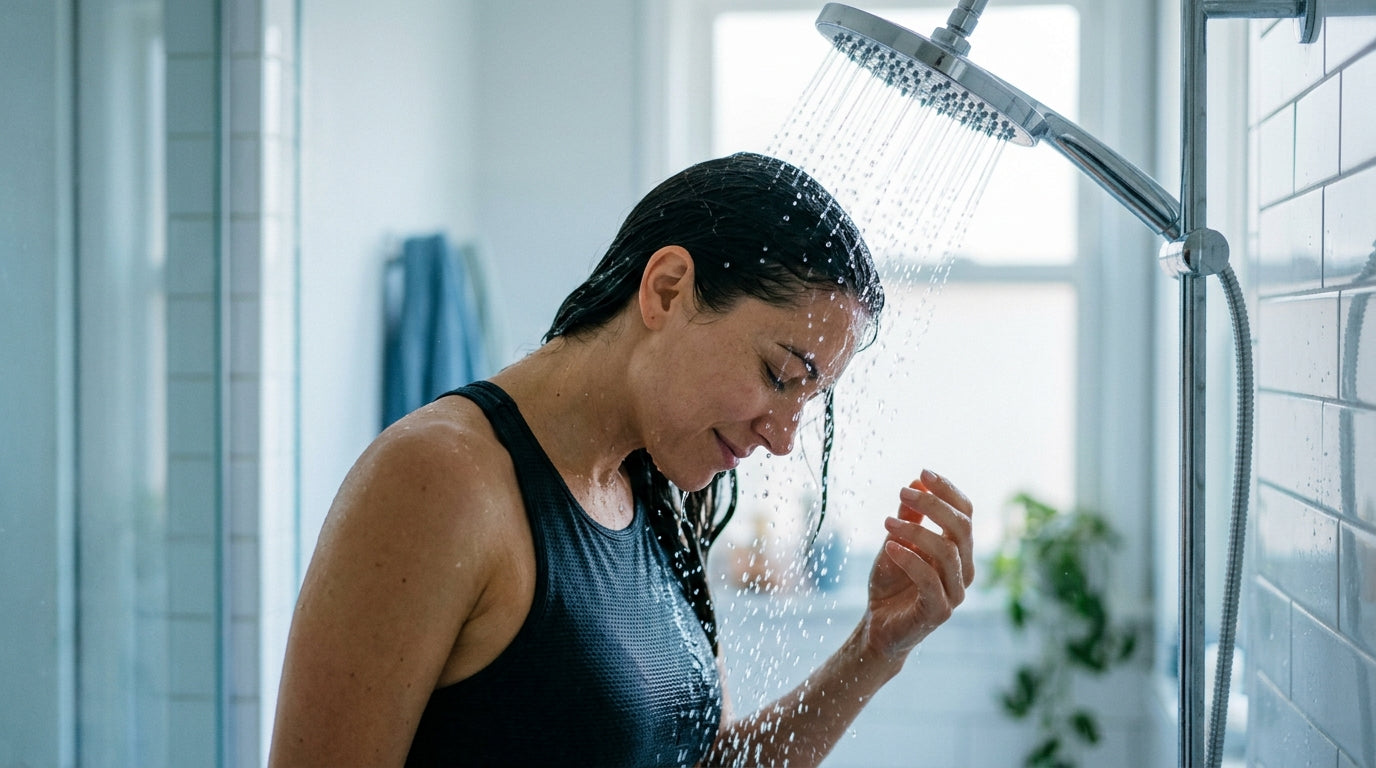
That tight, itchy feeling after a shower isn't in your head. Chlorine, chloramine, and heavy metals in your tap water can quietly aggravate acne, trigger eczema flare-ups, and undo the benefits of your carefully chosen serums. The fix is simpler than you'd think. Below, we've tested and ranked the best filtration shower head options for 2026, so you can find one suited to sensitive skin, baby-safe routines, K-beauty regimens, or anti-aging goals.
Why Tap Water May Be Sabotaging Your Skin and Hair
What's actually in your shower water
Most municipal water gets treated with chlorine or chloramine to kill bacteria. Good for safety. Bad for your skin. Both compounds strip away the natural oils that keep your skin barrier intact, leaving it dry, tight, and more prone to breakouts. If you've ever wondered whether your shower is quietly working against your skincare routine, it's worth reading up on does chlorine in tap water cause acne before you blame your cleanser or your diet.
Chlorine isn't the only issue, either. Depending on your municipal supply and the age of your home's plumbing, water can also carry heavy metals, PFAS, rust particles, and microplastics. None of these rinse off cleanly. They settle into pores and cling to hair strands, building up slowly over weeks and months of daily showers.
Then there's hard water, loaded with calcium and magnesium. It leaves a mineral film on your skin that blocks serums and moisturizers from actually absorbing. You could be using a $60 vitamin C serum and getting a fraction of its benefit. That's a frustrating, expensive kind of waste.
Who benefits most from filtering it
Anyone showering daily deals with some exposure, but a few groups feel it far more sharply. Babies have thinner, more permeable skin, so chloramine and residual chemicals irritate faster and show up as rashes or redness. Eczema-prone skin reacts the same way, often flaring within a day of a particularly harsh water cycle in your area.
Color-treated hair is another casualty. Unfiltered water oxidizes dye molecules faster, fading vibrancy and leaving strands duller and more brittle within just a few washes. If you've invested in salon color, comparing options like a Sans Filtered Showerhead against other filtration models can help you decide what actually protects your investment. Anti-aging shoppers should care too, since dull, dehydrated skin accentuates fine lines.
Bottom line: if your skin overreacts to everything, your shower water is a suspect worth investigating.

How to Judge a Filtration Shower Head
Not all filters do what the box claims. Some are barely more than a mesh screen with good marketing. Before you buy anything, it helps to know what actual proof looks like, versus what's just a nice photo of a lemon slice and the word "purifying."
Certifications worth checking
Third-party testing is the whole game here. If a brand won't say who tested the product or how, that's a signal to keep looking. Reading through best filtered showerheads of 2026, tested and reviewed is a good way to see how independent reviewers stack brands against each other rather than against themselves.
- Ask whether the filter has been evaluated by an independent lab rather than tested only in-house, since self-reported numbers are easy to inflate.
- Check for NSF/ANSI 53 certification, which covers reduction of specific health-related contaminants like certain heavy metals and chemicals.
- Look for NSF/ANSI 401 as well, since it addresses a broader group of "emerging" contaminants, including some pharmaceuticals and pesticides.
- Compare how many substances the filter is actually tested against — reducing chlorine alone is a low bar, while filters rated for 75-plus contaminants are doing far more work.
- Favor multi-stage filtration systems over single-cartridge designs, since layered filtration media tends to catch a wider range of particle sizes and chemical types.
- Give extra weight to dermatologist-reviewed or clinical skin testing, especially if you're buying specifically for acne, eczema, or sensitive skin concerns.
Red flags that signal weak filtration
Vague language is the biggest tell. "Removes impurities" means nothing without a number attached. Be wary of filters that list a single flashy contaminant on the front of the box but stay silent on everything else, or that skip water pressure data entirely. It's also worth understanding water contaminants that may irritate your skin before comparing products, so you know what you're actually trying to filter out. A filter that can't name its testing standard probably doesn't have one.

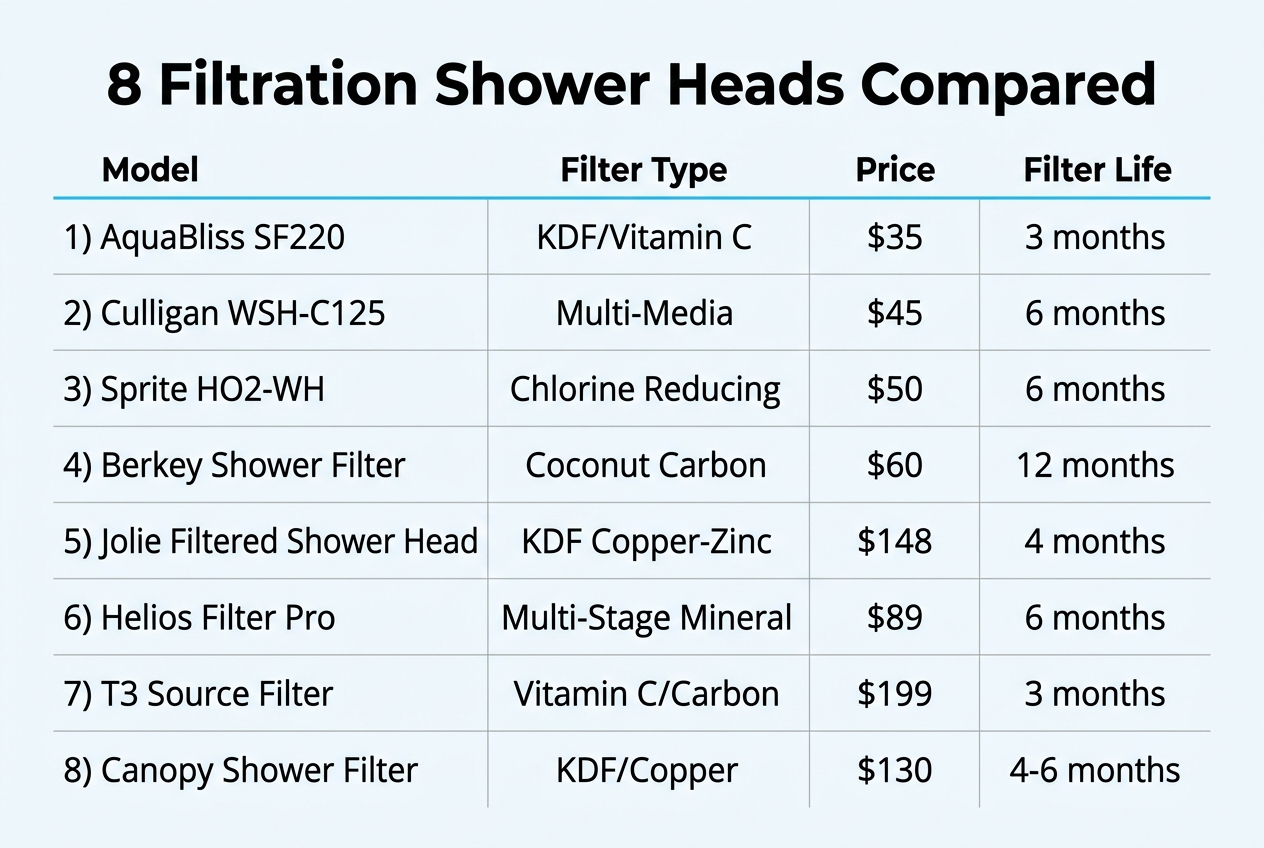
8 Filtration Shower Head Options Worth Comparing
Skincare-infused options vs. standard carbon filters
Not every filter does the same job, and that's the point. Some are built to strip out chlorine and grime. Others go further, adding skin-supporting ingredients while they filter. Knowing the difference matters more than picking whatever's cheapest on the shelf. A plain carbon filter will handle basic chlorine reduction just fine, but it won't do much for dullness, fine lines, or a stubbornly dry patch behind your ears.
The table below breaks down eight approaches by what they're actually built for, so you can match the option to the problem you're trying to solve.
| Option | Best for | Key feature |
|---|---|---|
| Vitamin C infusion 3-stage showerhead | Daily chlorine exposure and general skin support | Three-stage filtration plus vitamin C release with each shower |
| Antibacterial micro filter 3-pack | Chloramine-heavy municipal water systems | Targets bacteria and chloramine standard carbon often misses |
| Purifying core filter | Broad contaminant reduction (metals, rust, PFAS) | Wide-spectrum filtration for households wanting one solid baseline |
| Radiance glow-boost filter | Dull, tired-looking skin | Infusion blend aimed at brightening skin tone over time |
| Renewal anti-aging filter | Fine lines and elasticity concerns | Formulated to support firmer-feeling skin with regular use |
| Recovery collagen-boost filter | Firmness-focused routines | Collagen-support infusion paired with contaminant filtration |
| Hydration barrier-repair filter | Chronically dry or eczema-prone skin | Designed to reduce irritants that compromise the skin barrier |
| Standard universal showerhead filter | Budget-conscious buyers wanting basics covered | Simple carbon filtration, no infusion, easiest price point |
If you're new to this category, learn how water filters work understanding filtration science before comparing infused versus standard options, since the filtration stage is what everything else builds on. Infused filters cost more, plain and simple. But if you're already spending on serums and treatments, a standard carbon filter upstream might be undercutting that investment before it starts. For a broader market snapshot beyond skincare-specific brands, outlets like Best Filtered Shower Heads 2026 round up mainstream picks worth knowing about. Either way, match the filter to your actual skin concern, not just your budget.
filtration shower head installation and fit
Installing a new fixture sounds like a job for a plumber. It isn't. Most models use a universal threaded connection that screws directly onto your existing arm, no tools or tape required beyond what's already in the box. Whole setup, start to finish, usually takes under 10 minutes.
Step-by-step setup
The process is basically the same across brands, but a few details trip people up. Here's the breakdown:
| Step | What You Do | Time |
|---|---|---|
| 1 | Remove old shower head, wipe threads clean | 1 min |
| 2 | Check for existing rubber washer, replace if worn | 1 min |
| 3 | Hand-thread new unit clockwise until snug | 2 min |
| 4 | Attach mount or hose adapter if configuration is irregular | 3 min |
| 5 | Run water 30 seconds to clear carbon dust | 2 min |
Handheld setups, slide bars, and oddly angled arms are the usual holdouts. A mount and hose adapter kit solves most of these, letting you keep flexibility without sacrificing the seal. If you're weighing a simpler swap altogether, compare something like a Filtered Shower Head against multi-stage cartridge designs before deciding which fits your bathroom layout.
Troubleshooting common fit issues
Weak pressure is the top complaint, and it's rarely the filter's fault. Well-engineered multi-stage cartridges are built to maintain flow rate, not choke it. Leaks almost always trace back to two culprits: a missing or degraded washer, or threading that's been cranked too tight. Over-tightening actually causes leaks, not prevents them. Hand-tight plus a quarter turn is plenty.
Comparing Skin, Hair, and Scalp Benefits
For skin-focused users
The first thing most people notice is texture. Not overnight, but somewhere around the two-to-three week mark of consistent filtered showers, skin starts feeling less tight after towel-drying. That "squeaky clean but dry" sensation, the one chlorine leaves behind, tends to fade. Users with reactive or combination skin report fewer red patches on the chest and back, areas that take the brunt of shower spray and rarely get discussed in skincare routines focused only on the face.
There's also a practical payoff nobody talks about enough: your products actually work better. When skin isn't stripped and inflamed, serums and moisturizers absorb more evenly instead of sitting on compromised, irritated skin. That's a big deal if you're spending real money on retinoids or vitamin C serums. Filters built specifically around vitamin C or collagen-supporting formulas aim at glow and firmness as separate goals, since dullness and sagging aren't the same problem and don't respond to the same fix.
Don't expect a miracle in a week. Expect steadier skin over a month. That matters more.
For hair and scalp concerns
Scalp irritation follows a similar pattern to body skin, just with an added complication: product buildup. Shampoo residue mixed with mineral-heavy or chloraminated water can leave a film that irritates sensitive scalps and worsens flaking. Softer, filtered water rinses cleaner, which several dermatologist-reviewed reports link to calmer, less itchy scalps in people prone to redness or seborrheic-type flare-ups.
Color-treated hair is where the difference gets visible fastest. Chlorine and hard minerals oxidize dye molecules, which is why reds fade orange and cool blondes turn brassy faster than colorists expect. Filtered water slows that process, keeping tone truer between salon visits. If you shower daily and color your hair regularly, this alone can justify the switch. For anyone testing the waters before committing to a full plumbed system, trying a portable option like a Handheld Filtered Showerhead is a reasonable way to gauge results firsthand before upgrading further.
Replacement Filters and Subscription Options
How often to replace cartridges
Cartridge life isn't fixed. It depends on how often you shower, how many people use that bathroom, and how hard your water runs. As a general rule, plan on two to three months per filter before performance starts to drop off. Cities with harder water or heavier chlorine dosing will wear a cartridge down faster, so pay attention to flow rate and any change in smell as your cue to swap it out.
Buying single filters one at a time gets expensive. Honestly, it's easy to forget until you're already out. That's where multi-packs and auto-delivery plans earn their keep:
- A 2-pack covers roughly four to six months, a reasonable starting point if you're still testing whether filtered showers make a difference for your skin.
- A 4-pack stretches coverage close to a full year and lowers the cost per cartridge compared to buying individually.
- A 12-pack suits households with multiple bathrooms or heavy shower use, and it locks in the lowest per-unit price.
- Subscription or auto-delivery plans ship a fresh cartridge on a set schedule, so you're never showering through an exhausted filter without realizing it.
- Sink filter cartridges follow a similar two-to-three-month cadence, which means you can sync shower and sink swaps into one reminder instead of tracking two separate schedules.
- Bundles that pair shower and sink filters together tend to offer better long-term value than buying each system's cartridges separately.
If you're comparing options beyond cartridge economics, it's worth noting how other systems on the market handle replacement cycles too. The Hydroviv Filtered Showerhead uses a comparable multi-month cartridge interval, which gives you a useful benchmark when budgeting for upkeep. Skipping replacements doesn't just weaken filtration — eventually it does nothing at all. Set a reminder and treat it like changing a smoke detector battery.
What to Expect: Testing, Support, and Guarantees
Questions to ask before buying
Start with this one: was the product tested on actual people, or just in a lab beaker? A shower filter that's been evaluated on 200 or more adult participants tells you something a spec sheet can't. Real skin reacts to real water differently than a filtration chart suggests. Clinical validation on humans is the closest thing you'll get to proof it works for someone like you, not just in theory.
Next, ask about the testing standard behind any contaminant-reduction claim. Vague phrases like "removes impurities" mean nothing without a benchmark attached. NSF/ANSI 53 and NSF/ANSI 401 are the two certifications worth knowing, since they cover health-related contaminants and a broader list of emerging chemicals like PFAS. If a brand won't say which standard it used, that's a red flag, not a technicality.
Third, dig into who ran the tests. A third-party lab carries more weight than an in-house claim. And for shoppers who want a side-by-side gut check before committing, learning how independent reviewers approach the Best Shower Head Filter of 2026 (Data-backed rankings) can sharpen your own questions before you buy anything.
Finally, ask what happens after the sale. Does the company offer real troubleshooting if water pressure drops or a fitting doesn't seat right? Many local businesses installing plumbing fixtures will tell you: the install is easy, the follow-up support is where brands separate themselves. Twenty-four hour response windows matter more than they sound like they should, especially if you're mid-shower and something's leaking.
Cost adds up in ways that aren't obvious at checkout. Free shipping thresholds, often triggered somewhere around the $99 mark, can swing your total price meaningfully if you're buying replacement cartridges separately. Referral programs that knock 15% off for both parties are worth asking about too, since a filter you'll rebuy every few months benefits from that kind of recurring discount. Add it up over a year, not just one order.
Last, treat star ratings as one data point, not the whole picture. A 4.9-star average across hundreds of reviews is reassuring, sure. But pair it with actual lab numbers on chlorine, chloramine, or microplastic reduction. Ratings tell you people liked it. Data tells you why they should have.
If your skin and hair have been telling you something's off about your daily shower, it might be worth listening. Helios Filter's Vitamin C Infusion Showerhead and Sink Filters are dermatologist-tested on over 200 adults and manufactured in South Korea, with lab testing that shows a reduction of more than 75 contaminants like chlorine, PFAS, and microplastics. Visit Helios Filter today to explore their filters and bundles, and give your routine the clean water it deserves.
Share:
Is Your Tap Water Causing You to Break Out?
Under Sink Water Filter Systems: A Complete Buyer's Guide