

Your scalp's been flaking, itching, and burning no matter how carefully you wash it. Picking the right medicated shampoo for scalp eczema can feel overwhelming when every label promises relief but few explain how to actually use the product for results. It gets more complicated when hard water and chlorine are working against your efforts before the shampoo even gets a chance. This guide breaks down what to look for, how to apply it correctly, and what else in your routine, starting with the water itself, might be undermining your progress.
Before You Start: What You Need to Know First
Confirm the diagnosis with a professional
Scratchy, flaky scalp doesn't automatically mean eczema. It could be seborrheic dermatitis, psoriasis, plain old dandruff, or something else entirely. A dermatologist can tell these apart with a quick exam. That matters, because the shampoo you'd use for one condition isn't always right for another. Guessing wastes money. Worse, it can irritate your scalp further.
Get the diagnosis in writing, so to speak. Know whether you're dealing with atopic dermatitis, seborrheic dermatitis, or overlap of both — your doctor should name it plainly. Ask about your specific pattern too: is it mostly flaking, redness, itch, or weeping? That detail shapes which active ingredient (zinc pyrithione, ketoconazole, coal tar, salicylic acid) makes sense for you.
Before you stack a medicated shampoo on top of prescription creams or oral treatments, check with your doctor. Some combinations are fine. Others cancel each other out or overdry the skin. This guide assumes that conversation has already happened. It picks up from there, focused on using the shampoo well and managing the water environment around it.
Identify what's aggravating your scalp
Diagnosis is step one. Triggers are step two, and they're just as important. Stress, sweat, certain hair products, and seasonal dryness all show up on most eczema trigger lists. But one factor gets overlooked constantly: the water itself.
Hard water and chlorine exposure can aggravate a scalp barrier that's already compromised. Chlorine strips natural oils; mineral buildup from hard water can sit on the scalp and work against whatever shampoo you're using. If you've noticed flare-ups track with a move, a hotel stay, or a change in your water supply, that's not a coincidence worth ignoring. There's a reasonable body of work connecting does chlorine in tap water cause acne and similar skin irritation questions, and the same logic extends to a sensitized scalp.
Make a note of your water source — municipal, well, softened, untreated. It's a small detail now. It'll matter a lot once you get to adjusting your routine around it.
Step 1: Learn the Main Types of Medicated Shampoo for Scalp Eczema
Walk down the shampoo aisle and it's a wall of promises. But medicated shampoos really do split into a handful of active ingredients, each built for a specific job. Knowing which one you're looking at saves you money and guesswork.
Over-the-counter options vs prescription strength
Most people start with what's sitting on the drugstore shelf. Ketoconazole and zinc pyrithione shampoos target the yeast-related flaking that drives a lot of scalp eczema, while coal tar and salicylic acid work more on the scale itself — one slows skin turnover, the other softens and lifts it so it washes away. Selenium sulfide also fights yeast overgrowth but tends to smell stronger and needs a longer contact time. Prescription corticosteroid shampoos are the heavy hitters, reserved for active flare-ups rather than daily maintenance. If buildup from hard water is also matting your scale down, it helps to separately learn what a clarifying wash does before layering on medicated formulas, since best clarifying shampoo picks are built to strip residue, not treat skin.
| Active Ingredient | Best For | Availability | Typical Use Frequency |
|---|---|---|---|
| Ketoconazole / Zinc Pyrithione | Fungal-related flaking | OTC | 2–3x per week |
| Coal Tar | Thick, slow-turnover scaling | OTC | 2–3x per week |
| Salicylic Acid | Lifting and softening scale | OTC | 2–3x per week |
| Selenium Sulfide | Yeast overgrowth | OTC | 1–2x per week |
| Corticosteroid | Active inflammation flare-ups | Prescription | As directed, short-term |
Don't assume stronger always means better. Prescription steroids work fast but aren't meant for long-term, year-round use. Rotating or combining the right OTC formula often does the job just fine.
Step 2: Match the Shampoo to Your Scalp's Symptoms
Not all scalp eczema looks the same, and that's exactly why the shampoo aisle feels so confusing. Matching formula to symptom saves you money and spares your scalp weeks of trial and error. Before you grab whatever's on sale, take a minute to actually look at what your scalp is doing right now.
Matching severity to strength
Mild cases often respond to something you can grab without a prescription. Severe, angry flares usually need backup from a doctor. Here's a rough guide to sorting symptoms into the right strength category:
- Flaky, oily scalp with visible dandruff-like buildup often responds well to antifungal shampoos containing ketoconazole or zinc pyrithione, used two to three times a week.
- Thick, crusted patches that won't budge may need a coal tar or salicylic acid formula first, since these help lift and soften scale before any medicated treatment can actually reach the skin underneath.
- Red, inflamed, intensely itchy flares sometimes call for a short course of a prescription steroid shampoo, typically used for one to two weeks and tapered off once calm.
- Sensitive or broken, weepy skin needs fragrance-free, low-irritant formulas; anything with alcohol, sulfates, or heavy perfume will sting and can slow healing considerably.
- Children's scalp eczema requires pediatrician-approved, gentler formulations at lower concentrations, since young skin absorbs more and tolerates less than an adult's does.
- Overlapping symptoms, like flaky patches that are also cracked and sore, usually mean starting gentle and layering in strength only as needed, not the reverse.
Here's the blunt part: guessing wrong doesn't just waste a bottle. It can actively irritate already-angry skin. If you're unsure which category you're in, a pharmacist or your prescribing doctor can sort it out in minutes. Worth noting, too — hard water minerals and chlorine can mimic or worsen several of these symptoms, so it helps to understand water contaminants that may irritate your skin before assuming the shampoo itself is failing. Sometimes the formula's fine. The water it's rinsed in isn't.
Step 3: Build a Weekly Application Routine
Once you know which shampoo fits your symptoms, the schedule matters almost as much as the product. Start with the frequency printed on the label, typically 2-3 times per week, not daily. Apply it to a wet scalp, massage gently with fingertips (never nails), and let it sit for the directed contact time before rinsing. That wait time isn't filler — it's when the active ingredient actually works.
Sample weekly schedule
A simple weekly split helps you stay consistent without overdoing it. Here's a common pattern many people follow during an active flare, then taper once things calm down.
| Day | Wash Type | Contact Time | Notes |
|---|---|---|---|
| Monday | Medicated shampoo | 5-10 min | Lukewarm water only |
| Wednesday | Gentle regular shampoo | Rinse immediately | Lets scalp recover |
| Friday | Medicated shampoo | 5-10 min | Second weekly dose |
| Weekend | Rest day or water only | N/A | Skip if scalp feels raw |
Alternating medicated and gentle shampoo keeps the scalp barrier from getting stripped. Using medicated formula every single day sounds thorough. It's usually overkill, and it can backfire.
Signs you're overusing or underusing it
Too much tingling, stinging, or new redness right after washing usually means you're overdoing frequency or leaving it on too long. Too little change after three to four weeks, flaking that won't budge, suggests underuse or a mismatched formula. Keeping a short log — date, product, flare severity, water temperature — makes patterns obvious fast. If you're unsure how to adjust during an active flare, it helps to review guidance on how to treat scalp eczema during a flare before changing your routine. Also worth repeating: avoid hot water and scratching. Both worsen barrier damage no matter how disciplined your schedule is.
Step 4: Address the Water You're Washing With
Why rinse water quality matters for a sensitized scalp
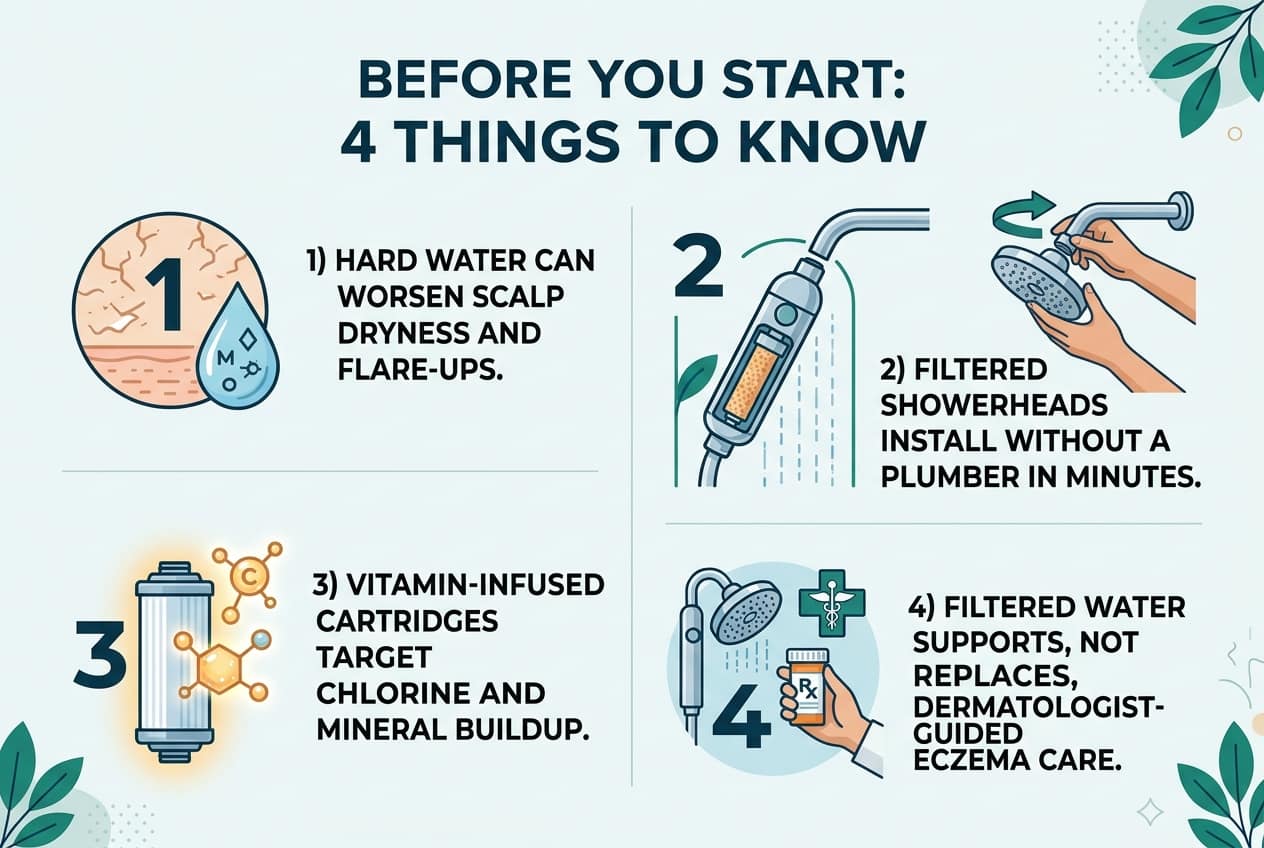
You can pick the perfect medicated shampoo and still feel stuck if the water rinsing it out is working against you. Hard water carries dissolved calcium and magnesium that settle onto the scalp as mineral deposits. That residue doesn't just sit there quietly — it can increase dryness and make it harder for shampoo to rinse away cleanly, leaving behind a film that trapped flakes and irritants cling to.
Then there's chlorine. Most municipal water supplies use it to keep water safe, which is great for public health and less great for a compromised skin barrier. Chlorine strips natural oils fast, and a scalp already dealing with eczema has little oil reserve to spare. Add those two factors together — scale plus chlorine — and you've got water that's quietly undoing some of your shampoo's work before it even has a chance to act.
A filtered showerhead is a simple fix for the shower side of this problem. It twists onto your existing arm in minutes, no plumber required, and it reduces chlorine and scale contact with every wash. That can make a sensitized scalp noticeably calmer between treatment days. Worth noting: vitamin-infused filter cartridges are part of that filtration process, not a topical product, and they don't replace the medicated shampoo itself. This step supports your routine. It's not a substitute for dermatologist-directed care, and it was never meant to be.
Step 5: Adjust for Hair Type and Lifestyle Factors
Tips for curly, color-treated, or textured hair
Medicated shampoo strips oil on purpose. That's how it calms an irritated scalp. But curly and textured hair relies on that oil to stay defined, and color-treated strands lose vibrancy fast once the cuticle dries out. So plan on a heavier conditioner, left on longer than usual, maybe five to ten extra minutes, to replace what the treatment removes.
Consider cutting back to two medicated washes a week instead of three, with a gentle co-wash or regular conditioner-only rinse on off days. That keeps curls hydrated without undoing the scalp benefits. If you color your hair, talk to your stylist about timing touch-ups around flare treatment, since fresh dye on an irritated scalp tends to sting more and fade quicker.
Buildup from hard minerals makes all of this harder. It coats strands and flattens curl pattern no matter how good your conditioner is. An in-salon clarifying or chelating treatment helps occasionally, but it won't stop new buildup from forming between visits; swapping in a filtered showerhead addresses the daily cause instead of just the aftermath, and it complements rather than replaces that salon treatment, with no plumbing involved. Many local businesses that specialize in curl care will say the same thing: water quality matters as much as product choice.
Considerations for a child's sensitive scalp
Kids' scalps are thinner and more reactive than adult skin. Look for tear-free, fragrance-light medicated formulas, and keep contact time short — often just one to two minutes before rinsing, well under what an adult routine might call for. Longer isn't better here. It just raises the odds of stinging and tears.
Renters with kids have it a little easier than they think. A filtered showerhead swaps on in minutes, no landlord sign-off needed, which matters if you're trying to reduce chlorine exposure in bath water fast during a flare without a lease dispute. It won't substitute for medical guidance, but treating the water touching a child's scalp daily is a reasonable supporting step. Reading up on customer reviews and testimonials alongside a pediatric dermatologist's notes can help you judge whether a given product or approach is worth trying before you commit.
If an esthetician referred you to filtered water as part of a broader routine, keep their notes and the product instructions lined up. Don't let one contradict the other. When in doubt, a quick message to whoever gave you the referral clears up more than guessing ever will.
Step 6: Know When to Loop Back to a Dermatologist
Medicated shampoo and filtered water can do a lot. They can't do everything. At some point, self-management stops being helpful and starts being stubborn. Know the difference.
Red flags that need prompt medical attention
Most scalp eczema improves gradually with the right routine. But certain signs mean it's time to stop experimenting at home and get a professional opinion instead. Don't wait weeks hoping things turn around on their own.
- You've used a medicated shampoo consistently, 2-3 times a week, for 4-6 weeks with no real change in flaking, itching, or redness — that's a sign the formula isn't matched to what's actually going on.
- Redness is spreading beyond the original patch, or you're noticing oozing, yellow crusting, or warmth to the touch, which can point to a bacterial or fungal infection layered on top of the eczema.
- Flares keep showing up even after you've cut out the usual triggers — switched shampoos, filtered the water, adjusted washing frequency — and nothing seems to move the needle.
- The itching is bad enough to disrupt sleep or daily focus, which usually means the inflammation has outgrown what an over-the-counter product can handle.
- You suspect a reaction to an ingredient in the shampoo itself, like fragrance or a specific active, and need a patch test to confirm it before trying something new.
- Your current shampoo used to work but has stopped, suggesting you may need a stronger prescription formula, like a higher-strength corticosteroid or a different drug class entirely.
A dermatologist visit isn't a failure of your routine — it's the next logical step when a condition needs more precision than a drugstore aisle can offer. Filtered water and the right shampoo are support tools, not a substitute for medical care when symptoms escalate.
Step 7: Maintain Long-Term Scalp Health Between Flares
Building sustainable habits
Here's the thing about eczema: it doesn't retire just because your scalp looks calm. It's a chronic, cyclical condition, and flares tend to return when you let your guard down. Keep your maintenance wash schedule going even when you feel fine — two to three times a week with your treatment shampoo is a common baseline. Consistency is what prevents the next flare, not reacting after it starts.
The water side of your routine needs the same consistency. If you're using a filter cartridge to cut chlorine and mineral exposure, a replacement filter subscription keeps performance steady without you tracking a calendar. Most cartridges lose effectiveness around the two-to-three-month mark; a subscription just gets a fresh one to you before that drop happens, which matters more than people expect.
For full coverage, pair a showerhead filter with an under-sink filter, or look at the showerhead + sink filter bundle. One handles hair-washing, the other handles the sink where you rinse your face and hands, often a dozen times a day. Treating only one spot leaves the other still exposed to hard water and chlorine, which somewhat defeats the point.
None of this replaces your dermatologist-recommended shampoo. That stays your primary treatment. Filtered water is a supportive daily habit sitting alongside it, not a substitute — and anyone selling it as a cure is overselling.
Wrap-Up: Putting the Routine Together
Seven steps, one goal: a scalp that isn't screaming at you. You started with diagnosis, learned the shampoo categories, matched one to your symptoms, built a weekly schedule, looked at your water, adjusted for your hair and lifestyle, and figured out when to call in backup. Laid out that way, it sounds like a lot. In practice, it's a routine you'll run on autopilot within a month.
Medicated shampoo stays the main event. Everything else — timing, technique, the water itself — just supports it. No filter or lifestyle tweak replaces a formula with pyrithione zinc, ketoconazole, or coal tar doing the actual work on inflammation and flaking. Think of filtered water as better soil, not a different seed. It reduces the mineral and chlorine load your scalp deals with between washes, which can make the shampoo's job easier, but it's a supporting actor, not the lead.
One more thing, and it matters: eczema changes. A routine that worked in October might fail by February. If symptoms shift significantly — new patches, bleeding, no response after a few weeks — go back to your dermatologist rather than troubleshooting alone. Routines are living things. Treat them that way.
Before deciding anything, it helps to get clear on what you're actually trying to fix: is it the water itself, the fixtures delivering it, or how your skin and hair are reacting to it, since those point toward different solutions. If testing or a specialist visit would give you better clarity on hardness levels or a skin concern, that's worth doing first rather than guessing. From there, it's really a question of scale and budget — a point-of-use change at the shower and sink is a much smaller commitment than a whole-home system, and knowing which problem you're solving makes that choice a lot easier.
Share:
Purple Shampoo for Gray Hair: Why Hard Water Ruins Your Results