
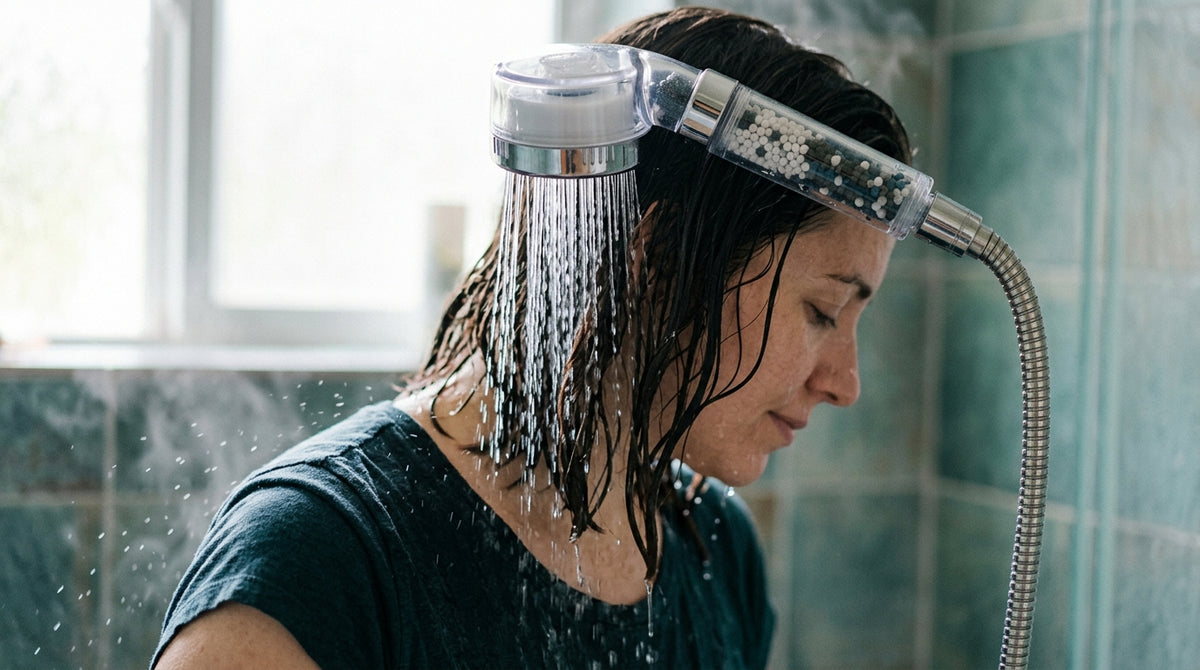
You've cycled through every medicated dandruff shampoo on the pharmacy shelf, and the flaking still comes back within days. That's frustrating. What if the shampoo isn't the problem, but what it's mixing with in your shower? Hard water and chlorine can blunt active ingredients before they ever get a fair shot at your scalp. This piece breaks down what actually works in 2026 — plus the overlooked variable undoing your results.
Why Dandruff Happens in the First Place
Common Triggers You Can Control
At its core, dandruff is usually one of three things: an overgrowth of malassezia yeast feeding on scalp oil, excess sebum giving that yeast too much to eat, or a dry, irritated scalp shedding skin faster than normal. Often it's some combination of all three. Your scalp isn't broken. It's reacting.
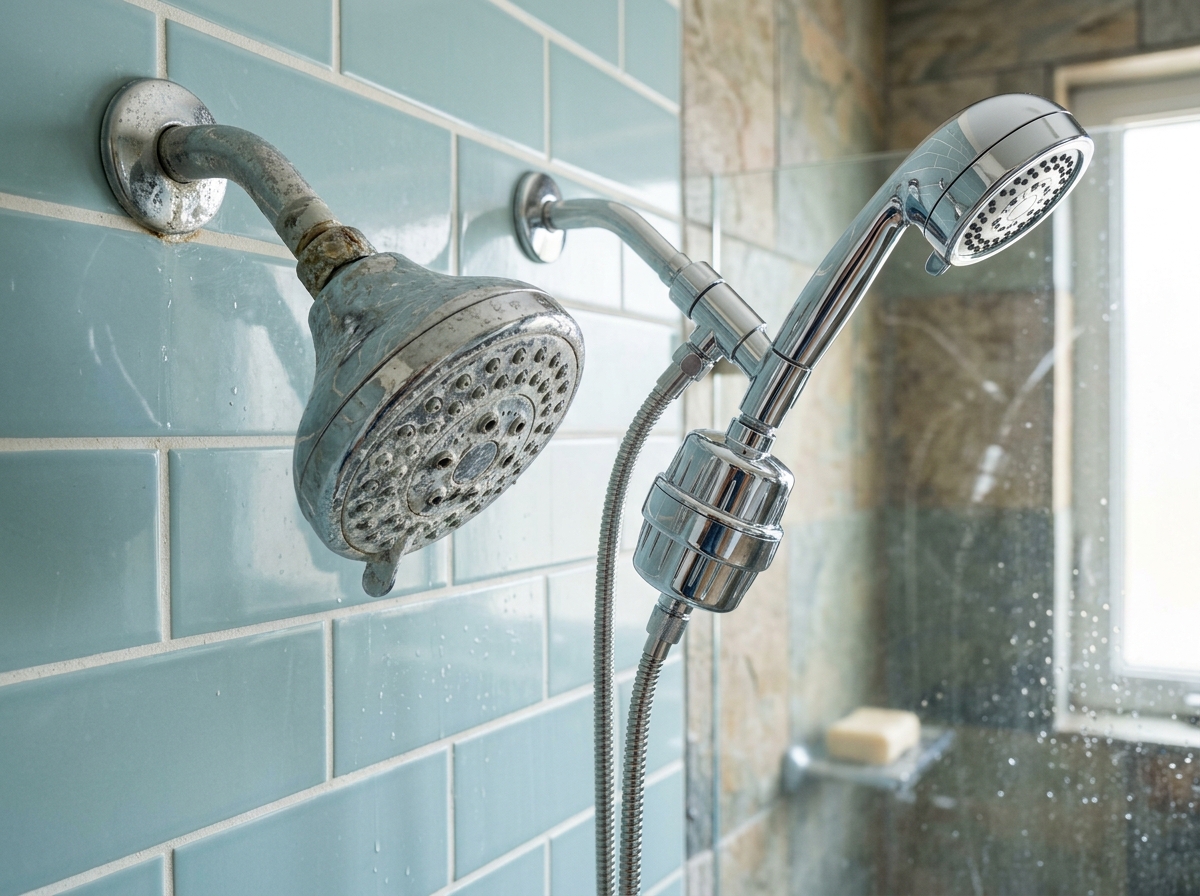
Stress is a classic trigger — it throws off oil production and inflammation levels. Cold, dry winter air does the same thing, and so does a hot shower that strips natural oils and leaves skin tight. Product buildup matters too: gels, dry shampoo, and heavy conditioners pile up at the root and feed flaking over time. Then there's the trigger most people never think about — mineral deposits from hard water settling onto the scalp with every wash, slowly coating it like a thin film you can't see but can definitely feel.
That mineral residue is worth dwelling on, because it's sneaky. It binds with shampoo and leaves a chalky layer behind, even when you're using a good product correctly. Over weeks, that buildup can make a mild case of flaking look a lot worse than it should. Many people chase new shampoos for months without realizing the water itself is working against them the whole time.
When It's More Than Just Flakes
Not all scalp flaking is dandruff, and that distinction changes how you should treat it. Dry scalp tends to produce smaller, drier flakes with less redness and oil. Seborrheic dermatitis, by contrast, brings yellowish, greasy scales and visible inflammation, often spreading past the hairline onto the ears or eyebrows. Psoriasis shows up as thicker, silvery plaques with well-defined borders, and it can be stubborn enough to need a dedicated provider's guidance rather than an over-the-counter fix.
Here's the blunt version: guessing wrong wastes money and time. A zinc pyrithione shampoo built for garden-variety dandruff won't touch psoriasis plaques. A heavy medicated formula meant for seborrheic dermatitis might just irritate a scalp that was simply dry to begin with. If flaking persists past a few weeks of consistent care, or comes with real redness, pain, or hair loss, it's worth a proper look rather than another bottle off the shelf.
Water quality complicates this picture further, since it's easy to blame a shampoo when the real culprit is what's coming out of the showerhead. Understanding does hard water cause dry skin helps explain why a scalp can feel tight, itchy, and flaky even when someone's doing everything their dermatologist or esthetician recommended.
How a Medicated Dandruff Shampoo Works
Every effective formula leans on one of three mechanisms: killing the fungus that triggers flaking, calming inflamed skin, or sloughing off dead cells before they clump into visible flakes. Some shampoos combine two. None do all three well, which is why picking blind off a shelf usually backfires. Knowing what's in the bottle lets you match the strength to your actual problem instead of guessing.
Antifungal Actives
Most dandruff is tied to an overgrowth of Malassezia, a yeast that lives on everyone's scalp but misbehaves in some people. Antifungal actives reduce that population directly. Ketoconazole and pyrithione zinc are the two you'll see most, and they work at different speeds and strengths depending on concentration.
Exfoliating and Anti-Inflammatory Actives
Salicylic acid and coal tar take a different route — they loosen dead skin cells and slow the turnover rate that causes buildup, rather than attacking yeast. Selenium sulfide does a bit of both. If your scalp's irritated and red, not just flaky, the anti-inflammatory angle matters more than exfoliation alone. The table below breaks down the four main actives you'll actually find on labels.
| Active Ingredient | Mechanism | Typical Strength | Best For |
|---|---|---|---|
| Ketoconazole | Antifungal, disrupts yeast cell membrane | 1% OTC, 2% prescription | Persistent, yeast-driven dandruff |
| Pyrithione zinc | Antifungal, mild antibacterial | 1–2% | Everyday maintenance, mild cases |
| Salicylic acid | Exfoliant, breaks down scale buildup | 1.8–3% | Thick, flaky scalp without much redness |
| Selenium sulfide | Antifungal plus mild anti-inflammatory | 1% OTC, 2.5% prescription | Combination flaking and irritation |
A quick, honest aside: there's no "strongest wins" rule here. Going straight for a 2.5% selenium sulfide formula when you've got mild, occasional flaking can leave your scalp dry and worse off. Separately, improving blood flow to the scalp is sometimes raised as a supporting habit, and research on circulation and massage offers some context on why that's plausible, though it's not a substitute for an active ingredient doing the real work. For a full rundown of what's in these formulas and how each compound is typically dosed, the showerhead filter ingredients glossary is a useful reference point before your next drugstore trip.
Comparing Popular Medicated Shampoo Options
Strength and Frequency Guide
Not every flaky scalp needs the same ingredient, and using the wrong strength too often can backfire fast. Some formulas are gentle enough for daily use. Others are clinical-strength and meant for short, targeted runs. Here's how the main actives stack up.
| Active Ingredient | Best For | Typical Frequency | Price Range | Scent Notes |
|---|---|---|---|---|
| Ketoconazole 1% | Persistent, fungal-driven flaking | 2x weekly, leave on 3-5 min | $14-$22 | Medicinal, mild |
| Selenium sulfide | Oily scalps, clinical-strength need | 2-3x weekly | $10-$18 | Strong, sulfur-like |
| Salicylic acid / coal tar | Thick scaling, plaque-like buildup | 2-3x weekly | $12-$25 | Tar-forward, polarizing |
| Zinc pyrithione | Sensitive, reactive scalps | Daily or every other day | $6-$15 | Light, fresh |
Price doesn't always track with effectiveness. A $7 zinc pyrithione bottle can outperform a $25 tar shampoo if your flaking is mild and reactive rather than fungal.
Best Picks by Scalp Concern
If your flakes come back stubbornly within days of washing, ketoconazole 1% is usually the strongest non-prescription option, since it targets the yeast most often behind chronic dandruff. Oily, flake-heavy scalps tend to respond better to selenium sulfide, though the smell turns some people off entirely — that's just the tradeoff. Thick, crusty patches call for salicylic acid or coal tar, which break down buildup mechanically rather than treating it chemically. Sensitive scalps, including kids prone to irritation, generally do best starting with zinc pyrithione daily before escalating.
One thing that trips people up: even the right shampoo underperforms if the water running through it is working against the formula. Mineral-heavy water can leave residue that blunts active ingredients before they finish their job. Recognizing signs your home has hard water often explains why a shampoo that worked at a friend's house does nothing at yours. It's also worth checking with an esthetician or pharmacist before combining two medicated formulas. Layering actives rarely speeds things up — it just irritates skin faster.
Getting the Most Out of Your Shampoo Routine
Buying the right bottle is only half the job. How you actually use it decides whether your scalp improves or stays stuck. Most people rinse too fast and wonder why nothing's changing.
Step-by-Step Application
Medicated shampoo isn't a quick lather-and-rinse product. The active ingredient needs real contact time with your scalp to do its job, and the order you do things in matters more than most people realize. Here's a routine that actually gives the formula a fair shot:
- Wet hair thoroughly first, since a dry scalp dilutes the shampoo unevenly and leaves patches undertreated.
- Apply the medicated shampoo directly to the scalp, not just the lengths, and work it in with your fingertips, not your nails.
- Massage for a full minute to spread the formula evenly before you even start the clock on contact time.
- Leave it sitting on the scalp for three to five minutes, which is the window most clinical formulas need to actually work; this single step is the one people skip most.
- Rinse completely, then follow with conditioner on the lengths only, keeping it off the scalp so you don't undo the treatment.
- Towel-dry gently rather than rubbing, since an irritated scalp is more reactive to everything that touches it next.
Skipping straight to conditioner, or using a 2-in-1, cuts that contact time down to almost nothing. Dandruff treatment guidance consistently points back to this detail: time on the scalp, not just the ingredient list, drives results.
How Often Is Too Often
More isn't better here. Daily use of a medicated shampoo can strip natural oils, trigger rebound dryness, and over time your scalp may simply stop responding to the active ingredient as well as it used to. Most dermatology guidance suggests two to three uses a week, alternating with a gentle, non-medicated cleanser on other wash days. That rotation keeps the scalp barrier intact while still giving the active ingredient room to work. Think of it as rationing a tool, not retiring it.
The Hidden Factor: How Hard Water Undermines Your Shampoo
Signs Hard Water Is Working Against You
You're using the right shampoo. You're following the directions. And the flaking still won't quit. That's usually the moment people start blaming the product, when the water running over their scalp might be the real culprit. Mineral deposits from hard water bind to scalp and hair, forming a fine film that sits right where your medicated actives need to land. Zinc pyrithione or ketoconazole can't absorb through a layer of calcium and magnesium buildup — they just sit on top of it.
There's a second problem working alongside it. Chlorine and hardness strip natural moisture from the scalp, which makes flaking look worse even right after you've treated it. You rinse, dry off, and see white flecks again within a day. That's not necessarily your shampoo failing — it's dehydration mimicking dandruff.
Plenty of customers only connect the dots after testing their water somewhere else and seeing high hardness numbers come back. Suddenly a stalled routine makes sense. The shampoo was never broken. It just never had a fair shot.
Point-of-Use Filtering vs Whole-Home Softening
Once hardness is identified as the missing piece, the next question is what to do about it. A filtered showerhead reduces the mineral and chlorine load reaching your scalp at the exact point it matters — the shower. It doesn't replace your shampoo or change its formula. It just gives the actives cleaner water to work through, instead of fighting past mineral film first.
This is a point-of-use fix, not a whole-house softening system. It won't treat the water in your washing machine, your kitchen tap, or your dishwasher. A whole-home softener handles every fixture in the house, but that's a bigger install, often needing a plumber and a much bigger price tag — and it's not something Helios offers.
If your goal is simply better results from the treatment you're already using, you don't need to soften the entire house. You need cleaner water where the shampoo actually touches your scalp, and that's a far smaller problem to solve.
Building a Scalp-Friendly Shower Setup
Pairing a filtered showerhead with the medicated shampoo you already use is one of the simplest upgrades you can make. Cleaner water helps active ingredients lather fully and rinse out completely, instead of leaving a filmy residue behind on your scalp. The shampoo still does the work — the water just stops getting in its way.
DIY Install Basics
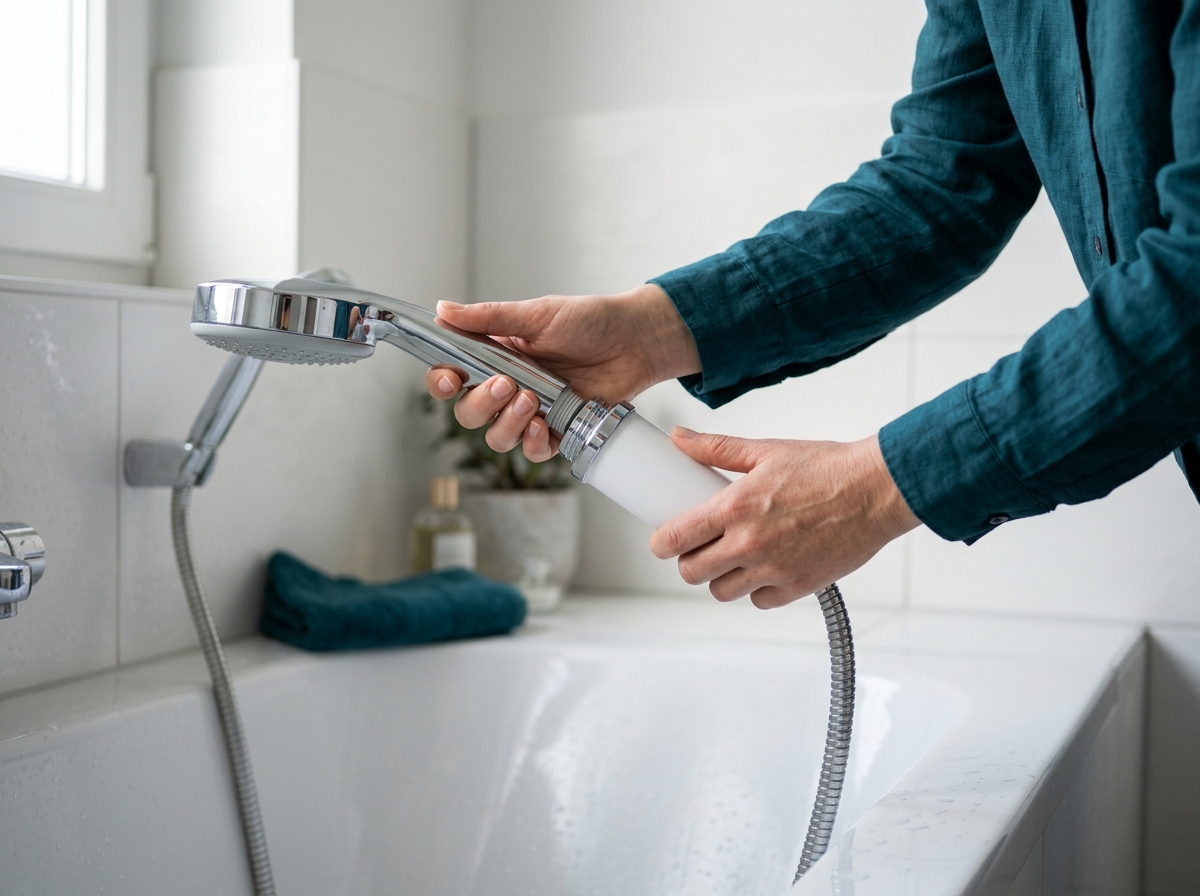
No plumber needed. That's the whole point. A filtered showerhead is designed to twist onto your existing shower arm in minutes, using the same threading as the fixture you've already got. It's a favorite among renters, since there's nothing to modify and nothing to undo when you move out. If you're troubleshooting a leak or a stripped valve, that's separate repair work for a plumber — this is strictly a swap-in upgrade, not fixture repair, and Helios doesn't handle installation labor or plumbing fixes.
What Filters Do (and Don't) Replace
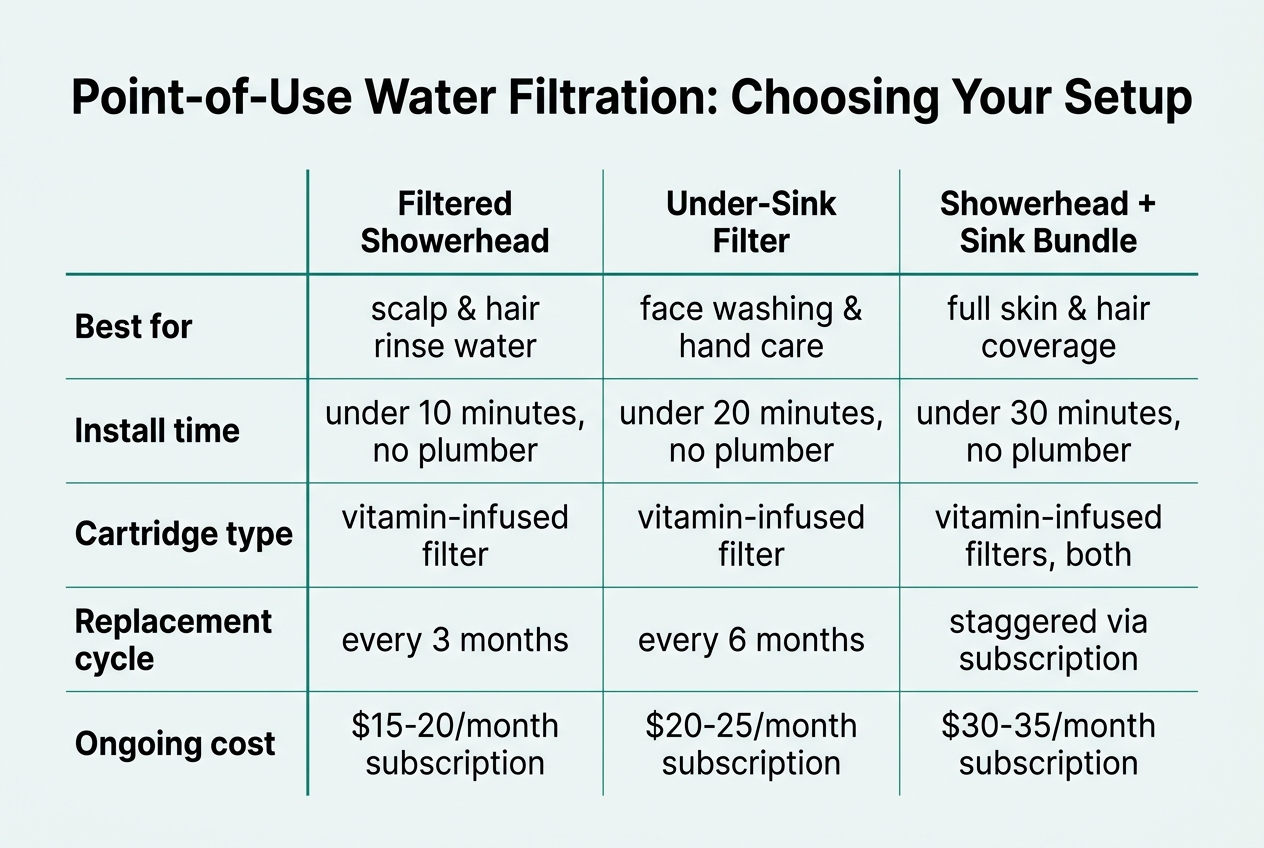
It's worth being clear-eyed about scope here. A filter changes water quality; it doesn't become your scalp treatment. Think of it as supporting infrastructure, not a substitute for anything medicated. With that framing, here's how the pieces typically fit together in a real routine:
- A filtered showerhead reduces chlorine and scale contact during the actual wash-and-rinse step, which is when your shampoo needs water to perform best.
- Vitamin-infused filter cartridges address water quality specifically — they're not a scalp treatment, and your medicated shampoo stays the star of the routine.
- An under-sink filter covers the sink tap, so face and hand washing get the same benefit without relying on shower time alone.
- A showerhead-plus-sink bundle tackles both daily touchpoints at once, which is more practical than treating them as separate projects.
- A replacement filter subscription keeps cartridges fresh automatically, so you're not tracking change dates or booking a service visit with a technician.
- None of this replaces a dermatologist for diagnosed eczema or scalp conditions — filtered water is a supportive change, not medical treatment.
Set up this way, your shower becomes a system that backs up the product doing the real work, rather than quietly working against it.
Frequently Asked Questions About Medicated Dandruff Shampoo
Treatment and Hair-Type Questions
No, and anyone promising a one-size fix is overselling it. Medicated shampoo works best on seborrheic dermatitis and run-of-the-mill fungal flaking, where ingredients like ketoconazole, zinc pyrithione, or selenium sulfide target the underlying yeast overgrowth. If your flaking comes from eczema, psoriasis, or simple dry skin, the same formula may do little or even irritate things further. That's why matching the active ingredient to the actual cause matters more than brand loyalty.
Color-treated and chemically processed hair can absolutely use medicated shampoo, but expect some fade, especially with selenium sulfide or coal tar formulas used frequently. Zinc pyrithione tends to be gentler on color. A practical workaround: use the medicated wash two or three times weekly and a color-safe formula in between, rather than medicating daily.
Rotating formulas every six to eight weeks helps prevent the scalp from adapting and the product losing effectiveness, a complaint dermatologists hear often. Alternating between two active ingredients, say ketoconazole and zinc pyrithione, tends to outperform sticking with one indefinitely.
When to Seek Professional Help
If flaking persists after six to eight weeks of consistent, correctly-used treatment, that's your cue to see a dermatologist. Persistent cases sometimes point to psoriasis or a scalp infection that over-the-counter products simply can't touch. Don't wait a year hoping it resolves itself — it usually won't.
Seasonal flare-ups, especially in winter, often stem from indoor heating drying out the scalp and from skin barrier changes in cold, low-humidity air. Consistent product use helps, but it won't override environmental triggers entirely, so expect to lean on treatment harder in January than in July.
Children's scalps are more sensitive, and pediatric eczema often masquerades as "just dandruff." Mild flaking can often be managed with gentle, fragrance-free cleansers, but persistent redness, cracking, or oozing calls for medical eczema care from a dermatologist rather than a drugstore medicated shampoo swap. When in doubt with a child, professional guidance beats guessing every time.
Before deciding anything, it's worth getting clear on what you're actually trying to fix: whole-home hardness calls for a dedicated softening system, while water that's simply rough on skin and hair at the shower and sink can often be addressed closer to where it touches you. If skin issues persist, a dermatologist's input matters more than any filter. The right next step really comes down to whether you're solving for the whole house or just the daily routine.
Share:
Sulfate-Free Shampoo for Dry Hair: Pairing It With Filtered Showers
Water Tap Filter Systems Compared: Which Type Actually Helps Your Skin?