

If your skin feels tight and your hair looks dull no matter what products you try, hard water at your own tap is likely the hidden culprit. You don't need to hire a plumber or overhaul your whole home to fix it. The right ro under sink water filter targets the exact water that touches your skin and hair every day, without professional installation. Below, we break down seven picks built for softer results in 2026.
How to choose the right ro under sink water filter for skin and hair goals
RO purification vs. skin-and-hair filtration: what each is actually for
Reverse osmosis exists to make drinking and cooking water as clean as possible. It's a workhorse for removing dissolved solids, heavy metals, and other contaminants at a single tap, usually the kitchen sink. That's a real, valuable job. But it solves a different problem than the one behind your flaky scalp or itchy forearms after a shower. Drinking water purity has almost nothing to do with what's happening to your skin and hair during the ten minutes you stand under a showerhead every day.
Think about the math for a second. You might drink half a gallon of water a day. You expose your skin to gallons more in the shower, and sink water touches your face and hands dozens of times daily while you wash up. If softer skin, fewer dandruff flakes, and shinier hair are the goals, the water at those two spots matters more than what's coming out of a drinking tap. That's why filters built for skin and hair take a narrower, more targeted approach: they go after chlorine and hard water minerals, the two culprits most linked to dryness, irritation, and dull-looking strands, rather than trying to strip out everything a full contaminant panel might flag.
This distinction shows up in how the products are built, too. Point-of-use filters designed for skin and hair install right at the shower arm or under the sink, no plumber needed, and they pair with cartridges infused with vitamins meant to counteract the drying effect of chlorine. They're not trying to compete with RO-level purification, and they shouldn't be marketed that way. If you're curious about the actual mechanism at play, it helps to read up on tap water effects on hair and skin before deciding which category of filter fits your situation. One more thing worth doing first: get a sense of your water's hardness level, often through a separate test, since that number tells you whether the problem is mineral buildup, chlorine, or both — and that answer decides which filter actually earns its keep.
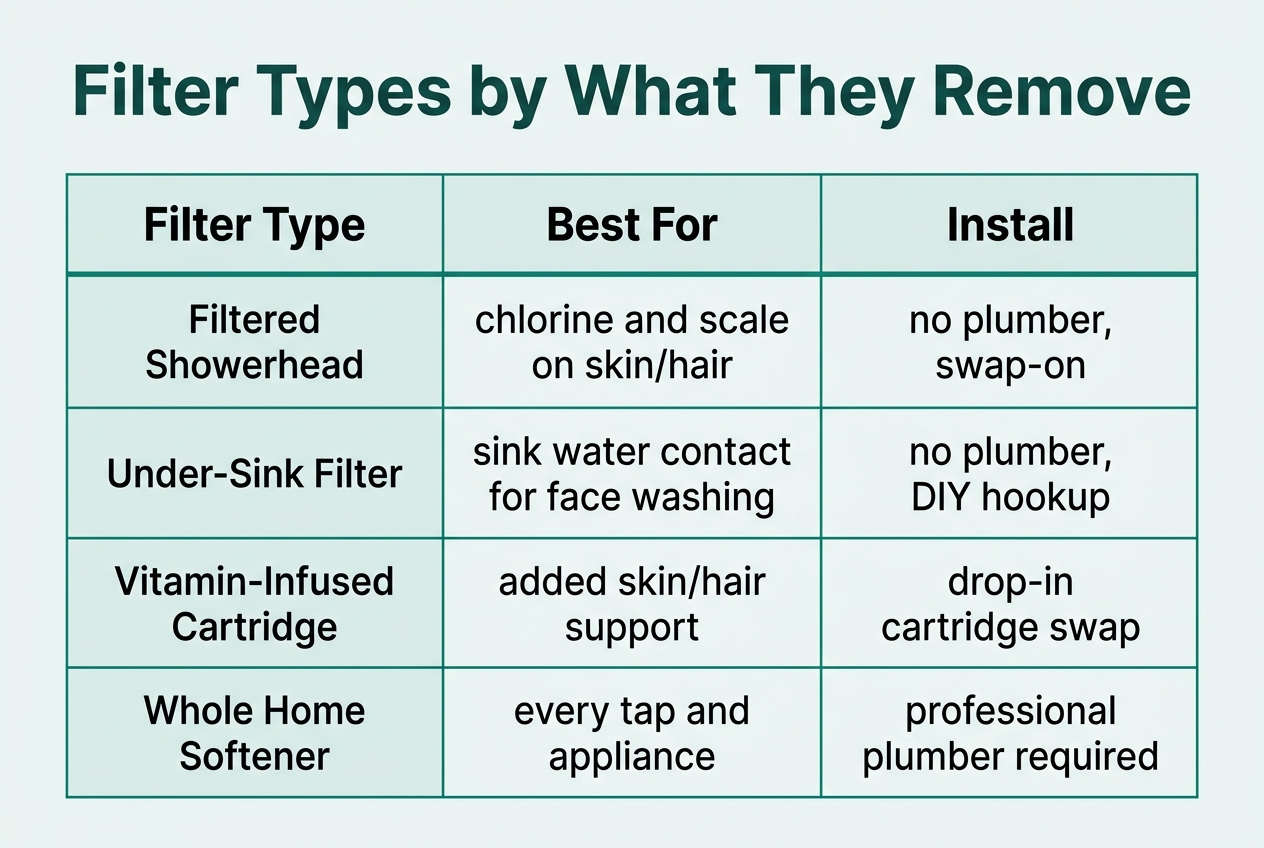
Comparing filter types by what they remove and who they're for
Not every filter is built for the same job. A multi-stage RO system is designed for drinking water purity, pulling out sediment, chlorine, and trace heavy metals through several cartridges before water reaches your glass. A tankless RO unit does similar work in a smaller footprint, often with faster flow but a higher price tag. Point-of-use filters, the kind you install on a showerhead or under a bathroom sink, take a narrower approach: they target chlorine and the mineral effects of hard water that dry out skin and dull hair. Here's how they stack up.
| Filter type | Stages | Primary purpose | Install complexity | Best for |
|---|---|---|---|---|
| Multi-stage RO (tank) | 4-5 stages | Drinking water safety, broad contaminant reduction | Moderate, usually professional | Households prioritizing purified tap water |
| Tankless RO | 3-4 stages | Same as above, compact footprint | Moderate to high, often professional | Small kitchens, on-demand drinking water |
| Point-of-use showerhead filter | 1-2 stages | Chlorine and hard mineral reduction for skin/hair | Low, DIY in minutes | Renters, dry skin, eczema-prone kids, color-treated hair |
| Point-of-use under-sink filter | 1-2 stages | Same goal, at the bathroom or kitchen tap | Low, no plumber needed | Face-washing, shaving, hand-washing routines |
The gap between these categories matters. RO systems chase purity for what you drink. They're not built to sit inline with your showerhead, and they won't touch the calcium and magnesium coating your scalp after a shower. Point-of-use filters skip the drinking-water claims entirely and focus on the water that actually touches your skin and hair. If you're weighing options, it helps to first learn whether does hard water cause dry skin in your specific case before picking a filter category. Many people run a quick hardness test elsewhere, then choose the point-of-use route for daily relief. It's a smaller fix. But it's aimed at the right problem.

Signs hard water is affecting your skin and hair, not your drinking water
Most people blame their skin problems on soap, weather, or stress. Rarely on the water itself. But hard water leaves calcium and magnesium residue on skin and hair with every single rinse, and that residue interferes with how your skin barrier holds moisture. It's not dramatic. It's slow, cumulative, and easy to miss until you know what to look for.
Here's what tends to show up when mineral-heavy water is the real culprit, not your drinking water quality:
- Your skin feels tight, itchy, or flaky within minutes of stepping out of the shower, even when you moisturize right after.
- Eczema patches that were manageable suddenly flare more often, especially after longer or hotter showers.
- Color-treated or curly hair turns dull and straw-like, losing bounce no matter how much conditioner you use.
- White or chalky spots build up on faucets, shower glass, and drinking glasses — a visible clue that minerals are heavier than they should be.
- Dandruff or a persistently itchy scalp sticks around even after switching shampoos two or three times.
- Lather feels thin and soap seems to sit on your skin instead of rinsing clean.
Any one of these on its own could be something else. But two or three together is a pretty strong pattern. Worth noting: these symptoms point to what's touching your skin, not what you're swallowing, so they're a different problem than signs your tap water might be contaminated would cover. If flare-ups feel more physical than cosmetic, some people also look into lymphatic drainage massage benefits as one piece of a broader routine, alongside whatever's happening with the water itself.
When to consider a hardness test before buying a filter
If you're seeing three or more of the signs above, testing first makes sense. A simple hardness test — sold cheap at hardware stores or through a lab kit — tells you whether you're dealing with moderately hard water or something closer to 15-20 grains per gallon. That number helps you decide how aggressive a filtering approach you actually need, instead of guessing. Skip the test if the visual clues are obvious and repeated. At that point, you already know enough to act.

DIY installation steps for a point-of-use filter without hiring a plumber
Tools you actually need (usually none)
Most point-of-use filters are built for hand-tightened fittings, so you can skip the toolbox entirely. An adjustable wrench helps if a connection is stubborn, and plumber's tape smooths out a stuck thread, but that's about it. No soldering, no cutting pipe, no special gear. If you're the type who reads instructions twice before touching anything, this project will feel almost anticlimactic.
Turn off the water and disconnect the old fixture
Before anything else, shut off the water supply. For a showerhead, that might mean the shutoff valve behind the wall or simply closing the main if there isn't one. For a sink filter, use the small valves under the cabinet. Then unscrew the existing showerhead by hand or with a wrench wrapped in cloth to avoid scratching the finish, or disconnect the sink's cold supply line at the fitting. Keep a towel nearby — a little residual water always finds its way out.
Attach, tighten, and test for leaks
Here's the sequence most installs follow, whether you're working at the shower arm or under the cabinet:
| Step | What you do | Time estimate |
|---|---|---|
| 1 | Shut off water supply at valve or main | 1 minute |
| 2 | Remove old showerhead or disconnect supply line | 3-5 minutes |
| 3 | Wrap threads with tape, attach filter housing per included fittings | 5-10 minutes |
| 4 | Hand-tighten connections, avoid overtightening plastic threads | 2 minutes |
| 5 | Turn water back on slowly, check every joint for drips | 2-3 minutes |
Run the water for a minute once everything's connected. Check each joint under light pressure before you trust it with a full shower or sink session. If you spot a slow drip, a quarter turn is usually the fix — not a full teardown.
Maintain it on a schedule, not a service call
Once it's installed, the only ongoing task is swapping cartridges on schedule, typically every two to six months depending on usage and filter type. There's no technician visit involved, because these units aren't designed around one. Some households test their water hardness first through a local lab or hardware store kit, then choose filtration based on what's actually in the water; if you're curious about your baseline, learning about the arsenic exposure risks tied to certain filtration methods is a useful reality check before assuming any single filter handles everything. A subscription for replacement cartridges automates the reminder, so you're not guessing when it's time.
Where a whole-home softener or well treatment system fits instead
Point-of-use vs. point-of-entry: matching the fix to the problem
A whole house water softener treats every drop that enters your home, from the kitchen tap to the washing machine to the outdoor hose. That's the point: it's a point-of-entry system, installed where water enters the house, and it requires professional plumbing work to tie into your main line. If your goal is uniformly soft water at every fixture, that's the category to look into elsewhere. It's a bigger investment, a bigger install, and honestly overkill if your only complaint is tight, itchy skin after a shower.
Well water brings its own headaches. Iron, sulfur, sediment, and sometimes bacteria show up in ways a shower or sink filter simply isn't built to handle. If your water smells like rotten eggs or stains your sinks orange, that's a job for a dedicated well treatment system designed to strip out those specific contaminants at the source. No point-of-use filter, however good, substitutes for that. Trying to fix a well problem with a shower filter is like putting a bandage on a leaky pipe.
Laundry is another separate lane. Hard water leaves minerals in fabric that dull colors and stiffen towels, but that's typically solved with an inline filter built for the washing machine's water line, not anything mounted at your shower or sink. Keep the categories straight: appliance protection, whole-home softening, well remediation, and skin-and-hair filtration are four different jobs, each with its own tool. Before deciding, many people start with general guidance on choosing a home water filter, which lays out how these categories differ before you spend money on the wrong one.
Point-of-use filters, like Helios's filtered showerhead or under-sink unit, solve a narrower but very specific problem: the water quality at the exact spot where it touches your skin, hair, or dishes. They install without a plumber, cost far less than house-wide equipment, and target chlorine and hardness effects right where you feel them daily. They won't soften your laundry water, treat a well, or purify drinking water to reverse-osmosis standards. What they will do is change how your shower and sink water feels against skin and hair, which for most people chasing softer skin or less scalp irritation is the actual goal, not whole-home mineral chemistry.
So the decision comes down to scope. Ask yourself what you're actually trying to fix: is it every tap in the house, or is it the two spots you stand at every morning? If it's whole-home water quality, softeners and well systems are worth researching separately, ideally after testing your water. If it's dry skin, flaky scalp, or hair that feels like straw after a shower, targeted point-of-use filtration is the more direct, less expensive route. There's no wrong answer here, but there's definitely a mismatched one.
What estheticians and parents look for in a filter recommendation
Why professional recommendations rarely suggest RO for this specific problem
Here's the thing about reverse osmosis: it's built for drinking water, not shower water. It strips out dissolved solids at the tap so you get cleaner water to sip, not softer water to rinse with. That's why most professionals steer clients toward point-of-use options instead — something you can install today, not something that requires a renovation or a plumber on speed dial.
Estheticians see the same pattern week after week. A client comes in with persistent dryness or breakouts that won't respond to product changes, and the water at home turns out to be the missing variable. Rather than recommend a whole-home overhaul, many point to filters that attach where water actually touches skin: the showerhead, the sink. Simple swap, no contractor.
Parents chasing down eczema triggers operate under similar logic, just with higher stakes. A pediatric dermatologist isn't going to say a filter cures anything — and it doesn't. Helios makes filters, not medical treatments, and it's not a stand-in for a dermatology visit. But chemical-reduction filtration as a supportive layer alongside medical care is a reasonable, low-risk step many parents take anyway.
Renters have their own non-negotiables. If it isn't reversible, it's off the table. That rules out softeners and most whole-home fixes entirely.
- Estheticians favor point-of-use filters for clients with dryness or breakouts because they skip renovation and deliver results at the exact fixture the client uses daily.
- Parents look for gentle, chemical-reduction filtration as one supportive piece of an eczema care plan, never a replacement for a dermatologist's guidance.
- Renters prioritize install-and-uninstall simplicity, since anything permanent or plumbing-heavy isn't realistic in a leased space.
- Curly-hair and color-treated hair owners look for chlorine and mineral reduction that helps preserve color vibrancy and cuts down on buildup between salon visits — filtered water works alongside a salon's clarifying treatment, not instead of it.
- Vitamin-infused cartridges get marketed as a complement to whatever skincare or haircare routine someone already trusts, not a substitute for it — Helios sells filters, not shampoos or lotions.
- Anyone managing a well water source needs to know point-of-use filters won't address iron, sulfur, or bacterial contamination, which fall under guidance on private well water treatment instead.
Notice the theme: every one of these groups wants targeted, reversible, low-commitment filtration. Nobody in this list is asking for a house-wide system. They want the water at one fixture to stop working against their skin and hair, and they want it fixed without waiting on a contractor's schedule.
Ongoing cost and maintenance: cartridges, subscriptions, and what to budget
Subscription vs. one-off cartridge purchases
Full reverse osmosis systems usually run three to five filter stages, each on its own replacement clock — a sediment pre-filter every few months, carbon stages once or twice a year, and a membrane that can last several years. Tank-based units sometimes need a technician to check pressure or swap the membrane correctly. That's a real cost, and it's easy to underestimate when you're only looking at the sticker price of the unit itself.
Point-of-use filters work differently. Most use a single cartridge, or sometimes two, replaced every two to six months depending on your water and how much you run through it. There's no membrane, no tank, no pressure valve to babysit. You twist off the old cartridge, drop in the new one, done. It's a five-minute job you do yourself, not a service call with a technician at your door.
Helios's replacement filter subscription is built around that simplicity. Cartridges ship on a schedule so you're not guessing when performance starts to drop, and you install them yourself — no technician visit, no rental fees, no equipment lease tacked onto your bill. It's the closest thing to "set it and forget it" that a self-installed system can offer, and it keeps the ongoing cost predictable instead of surprising you twice a year. Your recurring charge covers cartridges, not a leased unit — the hardware itself is yours outright.
If you've bundled a filtered showerhead with an under-sink filter, tracking two replacement schedules instead of one might sound like more hassle. In practice it's less, since both run on similar cadences and can ship together rather than arriving at random, unrelated times. That's worth factoring in if you're weighing a bundle against buying each fixture separately down the line.
Whatever route you pick, judge it by the yearly cartridge spend, not the box price. A cheap filter with pricey, frequent replacements can cost more by December than a pricier one that only needs two swaps a year. It's also worth knowing that filtration has real limits worth understanding — not every filter removes the same contaminants, so match the product to the problem you're actually solving: skin and hair comfort, not lab-grade water purity.
Before deciding, it's worth being honest about what problem you're actually solving — a dermatologist visit addresses a diagnosed skin condition in a way no filter can, and that's a conversation worth having with a professional rather than skipping past. But if the goal is simply reducing the chlorine and mineral exposure your skin and hair face every single day, that's a separate, smaller question you can answer for yourself: what's coming out of your shower and sink right now, and would softer, filtered water alongside your existing care routine actually make a noticeable difference. Ask what you're trying to fix versus manage, and let that distinction guide whether you need medical care, a filtration change, or both.
Share:
Antifungal Shampoo Guide: Treating Scalp Fungus Caused by Mineral-Heavy Water
Sulfate-Free Shampoo for Dry Hair: Pairing It With Filtered Showers