

You wash your face every day, but the water itself might be undoing your skincare routine before it even starts. Chlorine, chloramine, and heavy metals hiding in tap water can trigger dryness, breakouts, and eczema flare-ups, no matter how gentle your cleanser is. It's not just your imagination. The right sink water filter system can remove these irritants at the source, protecting sensitive skin, calming redness, and helping your favorite products actually work the way they're meant to.
Why Your Bathroom Faucet Water Might Be Sabotaging Your Skincare
How tap water contaminants interact with skincare routines
Here's the uncomfortable truth: the water you splash on your face every morning isn't neutral. Chlorine and chloramine get added to municipal supplies to kill bacteria, and they do that job well. But they don't stop working once they hit your skin. They strip natural oils from your face and hands during washing, breaking down the lipid barrier that keeps moisture locked in. That's part of why some people notice tightness right after cleansing, even with a gentle, sulfate-free formula. Ever wondered whether you should even bother washing your face with just water? The answer depends a lot on what's actually coming out of the tap.
Then there's what the water picks up on its way to you. Aging municipal pipes and household plumbing can introduce heavy metals, rust particles, PFAS, and microplastics into your daily rinse. None of that is visible. None of it smells like anything. It just accumulates, quietly, in the water you assume is clean simply because it's clear.
Municipalities test for safety thresholds, not skincare outcomes. Those are two very different bars.
Now think about what happens right after you wash your face. You pat it dry and reach for a $60 serum, expecting it to sink in and work its magic. But if residue from chlorine, minerals, or heavy metals is still sitting on your skin, that serum has to compete for space and absorption. Active ingredients like vitamin C or retinol perform best on a clean, balanced surface, not one coated in mineral film or oxidative residue left behind by treated water.
This is really the whole case for filtration as a skincare step, not a plumbing upgrade. You can layer on every product a dermatologist recommends, but if the water underneath is undoing the barrier before you even start, you're working against yourself. For a deeper technical breakdown, it's worth browsing independent under sink water filter systems we've tested comparisons to see how contaminant reduction actually varies by device and price point.

What to Look for in a Sink Water Filter System
Not all sink filters do the same job. Some just knock out chlorine taste and smell. Others are built to strip out a much longer list of contaminants, and that distinction matters a lot if skin sensitivity is your main concern. Before you buy anything, it helps to understand how water filters work understanding filtration science, since filtration stages and micron rating determine what actually gets caught versus what slips through.
Certifications and lab testing worth checking
Marketing claims are cheap. Third-party testing isn't. Here's what actually tells you a filter performs as advertised:
- NSF/ANSI 53 certification confirms a filter reduces specific health-related contaminants like lead and certain VOCs, not just aesthetic ones.
- NSF/ANSI 401 covers "emerging contaminants," a category that includes some pharmaceuticals and pesticide residues most basic filters ignore entirely.
- Contaminant reduction claims should specify a number and a list, so look for filters tested against 75 or more substances including PFAS, chlorine, and microplastics rather than vague "purifies water" language.
- Independent lab names and dates matter more than a brand's own internal testing, since anyone can say "clinically tested" without showing their work.
- Micron rating tells you the smallest particle size trapped; anything above 5 microns will miss a lot of fine sediment and some bacteria.
Installation compatibility with existing faucets
Even the best filter is useless if it doesn't fit your sink. Standard faucet threads vary, and pull-out or pull-down spray heads sometimes need a different adapter than fixed spouts. Look for a system that includes a mount kit and hose adapter options, since that's usually what separates a five-minute install from a frustrating trip back to the hardware store. If you're comparing broader options beyond a faucet-mounted unit, it's worth browsing Under Sink Water Filtration Systems to see how cartridge life and replacement cost compare over a year of use. Most cartridges last two to three months under normal use; factor that into your real annual cost before you commit.

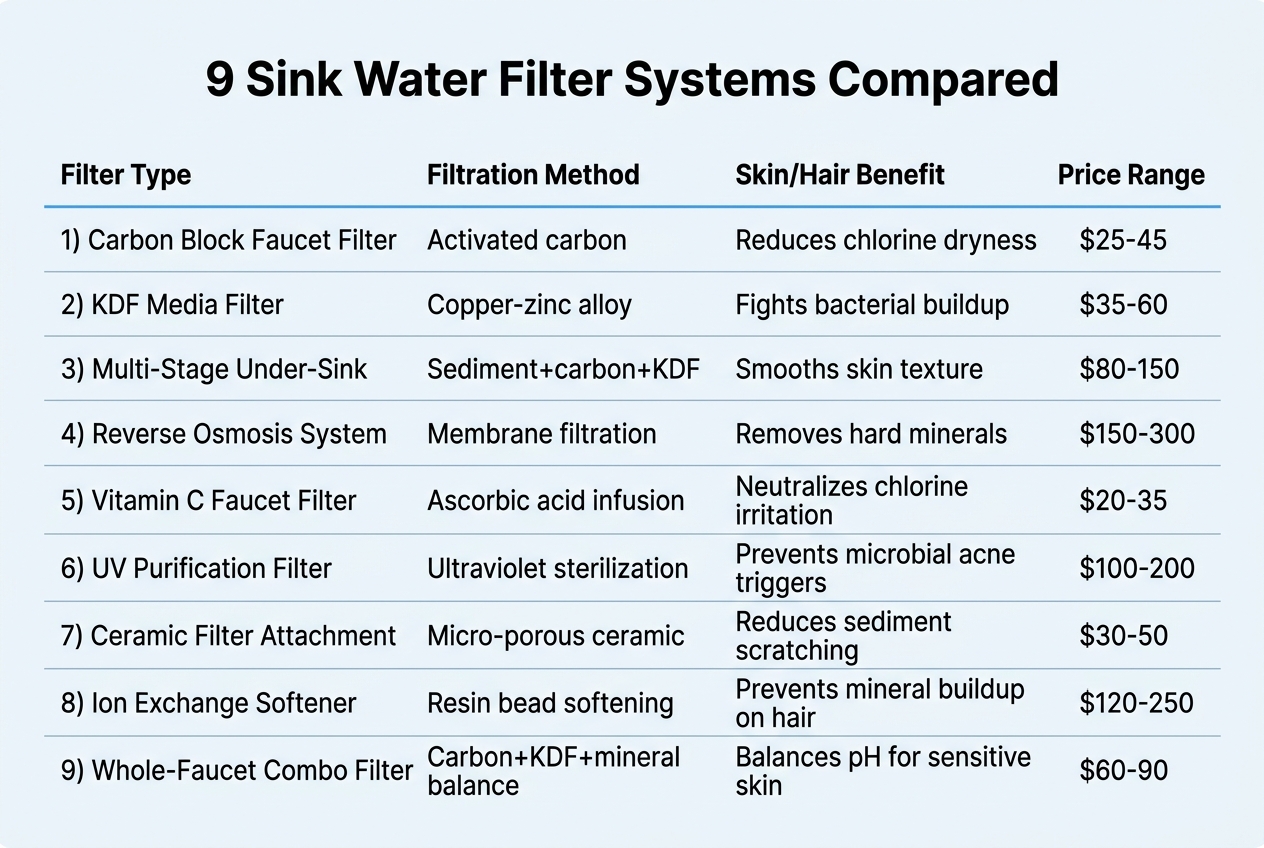
9 Sink Water Filter System Options Compared for Skin and Hair Benefits
Side-by-side specs and contaminant focus
Nine filtration paths get compared a lot, and honestly, most people just want to know which one fits their skin problem. So here's the short version before the details: brightening filters chase chlorine, purifying filters chase everything, and specialty filters chase a specific complaint like dullness or dryness. Contaminant focus matters more than marketing names. A filter built for chloramine won't necessarily touch PFAS, and one built for scale won't do much for bacteria.
| Filter Type | Primary Target | Best For | Typical Lifespan |
|---|---|---|---|
| Vitamin C infused sink filter | Chlorine, chloramine | Brightening, dryness relief | 2-3 months |
| Purifying core filter | Heavy metals, sediment, PFAS | Broad-spectrum protection | 3-4 months |
| Antibacterial micro filter (3-pack) | Bacteria, chloramine | Sensitive or reactive skin | 1 month each |
| Radiance / Renewal / Recovery / Hydration filters | Chlorine plus targeted actives | Glow, anti-aging, collagen, barrier repair | 2-3 months |
| Standard carbon block filter | Chlorine taste and odor | General household use | 3-6 months |
Standard carbon block filters, the kind you'll find in most hardware stores, handle chlorine taste fine but rarely touch chloramine or microplastics — that's the tradeoff. Multi-stage reverse osmosis under-sink systems go much further, stripping out dissolved solids and most contaminants entirely, but they're bulkier, pricier, and can strip beneficial minerals too. If you're weighing options broadly, browsing a Best Under sink filtration list gives a decent sense of what's mainstream right now. For skin-specific goals, though, targeted filters that address chlorine directly tend to matter more than raw filtration power. That's partly why research into vitamin c shower filter benefits keeps coming up in skincare circles — it's a narrower fix, but a relevant one for anyone dealing with tightness or flaking after washing up.
Step-by-Step: Installing a Sink Filtration System at Home
Tools and adapters you may need
Most sink setups take fifteen minutes, tops. You don't need a plumber, but you do need the right pieces on hand before you start, or you'll be dripping under the cabinet mid-install cursing at a wrench. Some faucets thread standard, some don't, and that mismatch is the number one reason installs stall out. Comparing an Under Sink Water Filter against a faucet-mounted unit ahead of time also helps you decide which adapters you'll actually need before you buy anything.
| Step | What you do | Tool or adapter needed | Time |
|---|---|---|---|
| 1 | Shut off water, remove old aerator | Adjustable wrench or pliers | 2 min |
| 2 | Attach mount or hose adapter | Adapter kit, plumber's tape | 3 min |
| 3 | Connect filter housing | Filter unit, hand-tighten only | 3 min |
| 4 | Flush carbon fines | None — just run water | 2 min |
| 5 | Check for leaks | Paper towel, flashlight | 2 min |
Start by turning off the water supply valve under the sink, then detach the existing aerator by hand or with pliers wrapped in cloth to avoid scratching the finish. Next, attach the mount or hose adapter kit, wrapping threads with plumber's tape for a tighter seal. Connect the filter housing and hand-tighten the fittings; overtightening with a wrench can crack the plastic casing. Run the water for two full minutes to clear loose carbon fines, which is normal and not a defect. Finally, test the flow and inspect every connection point for leaks before you trust it for daily use.
Matching a Filter to Your Skin Concern
Not every skin type needs the same fix. Your filter choice should follow your actual concern, not just whatever's cheapest or most hyped online. Think of it like choosing a serum: you match the active ingredient to the problem, not the other way around.
Sensitive skin and eczema-specific considerations
Eczema and reactive skin flare up easily, so the wrong filter (or none at all) can undo weeks of careful treatment in a single shower. Look for dermatologist-tested, low-irritant filtration before anything else. New parents face a similar stakes-are-high situation: baby skin is thinner, more permeable, and less tolerant of harsh residue. If you're weighing sink options for the kitchen or bathroom vanity too, comparing under-counter water filtration options can help you understand what's realistic for whole-household filtering versus a single showerhead swap.
- Acne-prone and oily skin types benefit most from chlorine and bacteria reduction, since both can worsen breakouts and clogged pores over time.
- Eczema and generally sensitive skin need low-irritant, dermatologist-tested filtration rather than a generic carbon filter picked at random.
- New parents should prioritize chloramine and heavy metal reduction first, since infant skin barriers are far less developed than adult skin.
- Anti-aging focused users often do better with collagen-boost or renewal-style formulations that pair filtration with skin-supportive minerals.
- K-beauty devotees tend to pair Korean-manufactured filters with existing serum and essence routines, treating filtered water as step zero rather than an afterthought.
- Color-treated hair benefits from any of the above, since chlorine exposure fades pigment regardless of your underlying skin concern.
Here's the blunt part: buying a filter that ignores your actual skin issue is just an expensive placebo. Match the mechanism to the problem, and you'll actually see a difference within a few weeks of consistent use.
Pros and Cons of Vitamin-Infused vs. Standard Carbon Filters
When added actives are worth the extra cost
Here's the real question: do you need extras like vitamin C, or just clean water? Vitamin C infusion neutralizes chlorine's swimming-pool smell and may support skin brightening over time, which matters if dry, dull skin is your main complaint. Standard carbon filters skip the actives entirely. They focus on broad contaminant reduction: chlorine, sediment, some heavy metals. No frills, no fragrance, just filtration doing its job quietly.
That simplicity has a cost, though — not a financial one, a functional one. Standard filters won't target specific skin concerns the way infused cartridges try to. If eczema or barrier repair is your priority, plain carbon won't get you there alone. Before installing anything, it's worth reading through real feedback from under-sink filter owners to see how expectations match reality once the novelty wears off.
| Feature | Vitamin-Infused Filter | Standard Carbon Filter |
|---|---|---|
| Primary function | Contaminant reduction + skin actives | Contaminant reduction only |
| Typical cartridge lifespan | 4–6 weeks | 2–6 months |
| Cost per cartridge | Higher | Lower |
| Skincare-specific benefit | Yes (brightening, hydration support) | No |
| NSF/ANSI testing available | Depends on brand | Depends on brand |
Notice that last row. Both categories can carry NSF/ANSI 53 or 401 certification — it's not exclusive to fancier cartridges. A reputable standard filter tested to those standards may outperform an untested infused one. Don't assume added actives mean better lab-backed performance; check the paperwork, not just the ingredient list.
Maintenance, Replacement Schedules, and Getting the Most From Your System
Setting up a reminder or subscription cadence.
Cartridge lifespan isn't one-size-fits-all. Most sink filters last somewhere between one and three months, depending on how many people use the sink and how hard your local water runs. A single-person household in a low-mineral area might stretch a cartridge closer to the three-month mark, while a busy family bathroom with hard water will burn through filtration capacity faster. Track your usage, not just the calendar.
The easiest fix for forgetting a swap is to stop relying on memory altogether. Auto-reorder or subscription plans quietly handle the timing for you, shipping a fresh cartridge right before the old one taps out, so there's no gap where you're showering or washing your face in unfiltered water again. If you're weighing options beyond a single-brand plan, browsing broader under sink filtration systems can help you compare typical replacement intervals across different setups.
Watch for three warning signs: slower flow at the tap, any odor creeping back, or water that looks slightly discolored. Any one of those means the filter's media is saturated and it's done its job — time to swap it out, not squeeze out another week.
Buying single cartridges one at a time is the expensive way to do this. Multi-packs — think 2-pack, 4-pack, or 12-pack bundles — bring the per-unit cost down noticeably, which matters if you're maintaining filters on both a shower and a sink. Stack that with free shipping thresholds and referral discounts, and the long-term cost of staying protected drops quite a bit. It adds up faster than you'd think.
If your skin feels tighter or duller than it should after washing up, the water coming out of your tap might be the culprit—and it's worth doing something about. Helios Filter makes that easy with their Helios Sink Filter, infused with Vitamin C and manufactured and clinically tested in South Korea to reduce over 75 contaminants like chlorine, PFAS, and microplastics. Visit Helios Filter online today to find the right filter for your sink and start giving your skin the cleaner water it deserves.
Share:
How to Choose the Right Water Filter for Your Tap
Bath Tap Water Filters: Do You Need One for Softer Skin?