
Your flat iron can only do so much if the water hitting your hair every morning is already working against you. You've probably scrolled through dozens of roundups searching for the best heat protectant for hair, only to keep landing back at dull, straw-like strands no serum seems to fix. Here's the catch: hard water and chlorine quietly degrade hair before a single hot tool ever touches it. This list covers the 12 formulas worth your money, plus the overlooked water fix that makes every one of them work better.
How we picked the best heat protectant for hair
What makes a protectant actually work
We built our criteria around five things that actually matter, not marketing copy. First: heat tolerance. A real protectant should hold up to 450°F, since that's where most flat irons and curling wands top out. Second, ingredient quality. We looked for silicones, polymers, and proteins that form an actual barrier, not just glycerin and fragrance dressed up as protection. Third, the hold-versus-weight tradeoff. A spray that protects but leaves hair stiff isn't doing you any favors.
We also tested across fine, curly, color-treated, and gray textures. A formula that works on silky fine hair can weigh down curls or feel greasy on gray strands, which tend to be drier and more porous. Price per ounce mattered too. Some $28 bottles outperformed $12 ones by a wide margin, and some didn't. Versatility was the tiebreaker whenever two products scored close.
None of this works in isolation, though. A protectant can be flawless and still lose the fight if what's coming out of your showerhead is undoing the job before you even reach for a flat iron.
Where most reviews fall short
Most roundups stop at the bottle. They judge shine, smell, and frizz control, then call it a day. What they skip is the water your hair meets every single wash, and that's a bigger variable than people realize. Minerals in hard water coat the hair shaft, roughen the cuticle, and make strands more porous. So heat protectant has to work twice as hard to seal in moisture it never fully absorbed. Reading up on what's actually in your water is a logical first step before you spend money on serums.
That's a detail worth sitting with. You can buy the best spray on the shelf and still get crispy ends, because the damage started at the root, literally. Our testing accounted for this by flagging which products performed best on hair exposed to harder water conditions versus filtered, softer water, a distinction almost no other review mentions. It's not the whole story, but it's one most lists leave out entirely, and it changes how you should read every ranking below.
The 12 best heat protectant sprays, creams, and primers
Best overall and best for fine or damaged hair
Let's get the obvious question out of the way: does the "best" heat protectant even matter if your water is working against it? We'll get to that later. For now, here's what actually performs well on fine, damaged, or chemically treated strands, where the margin for error is thin and breakage shows up fast.
- Unite 7Seconds Detangler doubles as a leave-in and a light protectant, making it a smart pick for fine hair that gets weighed down by heavier creams.
- Verb Ghost Heat Protectant Primer is weightless and alcohol-light, so it won't leave fine strands feeling stiff or brittle after styling.
- Oribe Dry Texturizing Spray protects while adding grip and body, which is handy if your hair is damaged and limp rather than just dry.
- Dae Agave Heat Protection Mist leans on lightweight agave and rice protein, a gentler formula for strands already stressed by color or bleach.
- LolaVie Perfecting Leave-In combines detangling, frizz control, and heat defense in one step, which cuts down on product layering for damaged hair that bruises easily under too much handling.
- Moroccanoil Perfect Defense is a long-standing favorite for a reason: it coats strands evenly without the greasy residue some oil-based sprays leave behind.
If you're noticing dullness or straw-like texture even with a solid protectant, mineral buildup from your shower water could be part of the story. We unpack that fully in a later section on hard water's effect on styling results.
Best for curly, color-treated, and gray hair
Curly, color-treated, and gray hair all share one enemy: porosity that lets heat and moisture escape too fast. These picks are built to slow that down, whether you're diffusing curls, flat-ironing color-treated lengths, or fighting the wiry texture gray hair tends to develop.
- Briogeo Color Me Brilliant Heat Protection Primer is formulated to guard color molecules, so it's a solid pick before blow-drying freshly dyed hair.
- AG Firewall Argan Shine Spray adds gloss while sealing the cuticle, which helps curly hair resist the frizz that humidity and heat both trigger.
- Drybar Hot Toddy Heat Protectant Mist is a favorite among stylists for blowouts, since it protects without flattening curl pattern or volume.
- Redken Thermal Spray 22 offers higher heat resistance, a good match for coarse or gray strands that need hotter tools to style smoothly.
- Paul Mitchell Hot Off The Press smooths and protects in one pass, useful for color-treated hair prone to flyaways after flat-ironing.
For a budget pick under $15, it's hard to beat a basic drugstore thermal spray. Most deliver the same core silicone-and-polymer protection as pricier bottles, just without the added fragrance or packaging. That said, no protectant fully offsets what hard water does to color and curl over time; mineral deposits dull pigment and roughen the cuticle, a pattern echoed in independent research on hair and skin texture changes and in broader discussions of how does hard water cause dry skin, which applies just as much to your scalp as your face. If you're coloring or growing out gray and still seeing flat results, the water hitting your hair every day deserves a second look.
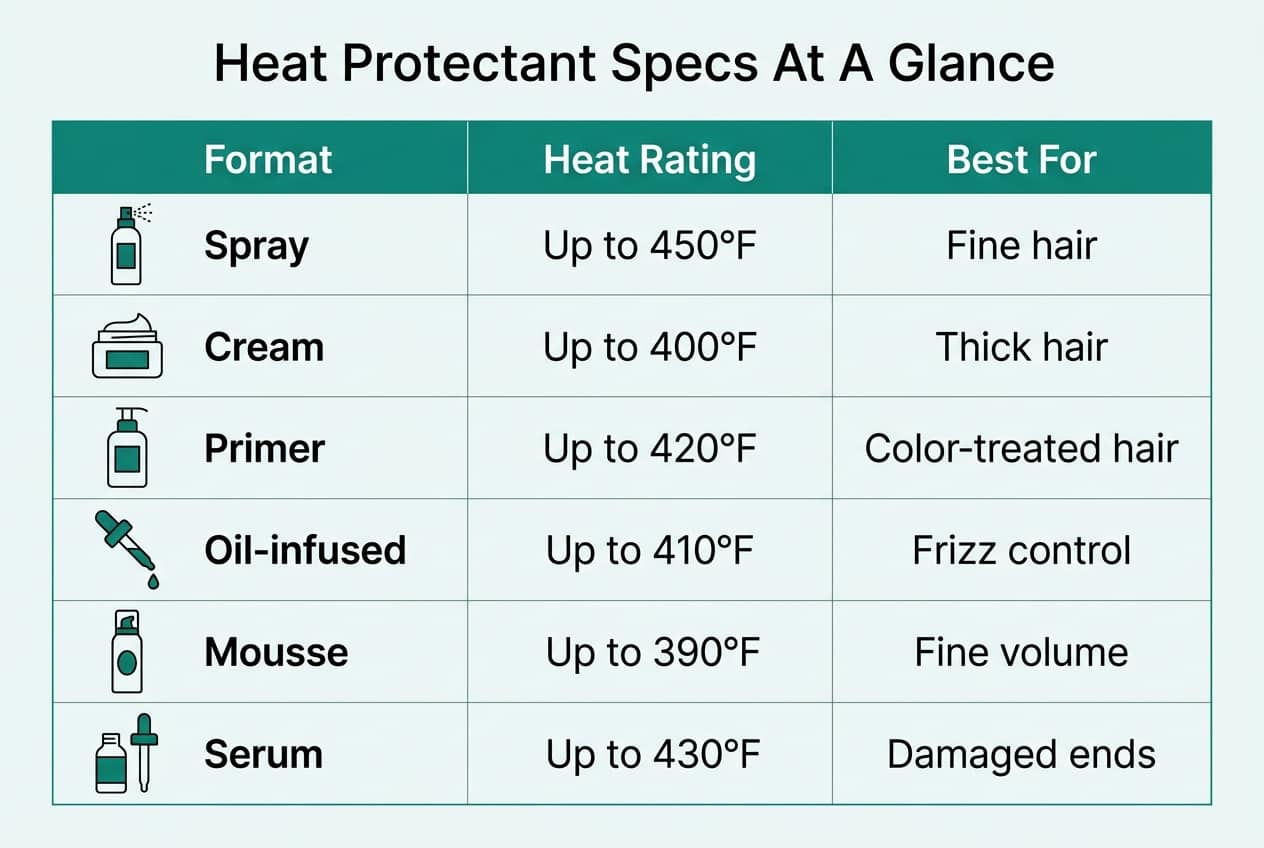
Quick comparison: heat protectant specs side by side
Lightweight sprays vs cream formulas.
Before you commit to a bottle, it helps to see the numbers side by side. Sprays tend to run thinner and dry fast, which suits fine or straight hair that gets weighed down easily. Creams sit heavier and work harder on coarse, curly, or color-treated strands that need more coating to resist a hot iron. Heat tolerance, price, and hold level all shift depending on which camp a product falls into. Scan the table below before you decide.
| Product type | Heat tolerance | Price | Best hair type | Hold level | Key ingredients |
|---|---|---|---|---|---|
| Lightweight spray | Up to 400°F | $12–$22 | Fine, straight, oily scalp | Light, no residue | Dimethicone, panthenol |
| Rich cream | Up to 450°F | $18–$30 | Curly, coarse, color-treated | Medium-firm, frizz control | Shea butter, cyclopentasiloxane |
| Serum-spray hybrid | Up to 420°F | $20–$35 | Wavy, damaged, chemically treated | Light-medium, shine boost | Argan oil, amodimethicone |
| Mist primer | Up to 380°F | $10–$18 | Thin or thinning hair | Minimal, volumizing | Hydrolyzed keratin, glycerin |
Notice the pattern: higher heat tolerance usually means a thicker formula and a slightly bigger price tag. That's not a coincidence. Creams need more polymer density to shield coarse strands at 450°F, and that density costs more to produce. If you're testing a new product on hair that's already stressed from mineral buildup, it's worth knowing what's actually hitting your strands before the heat does. Learning more about water filter for tap options can clarify why some protectants seem to underperform at home versus in a salon chair.
Ingredients that separate a good heat protectant from a gimmick
What to avoid on the label
Flip the bottle over before you buy. A real heat protectant leans on silicones like dimethicone or cyclopentasiloxane to form a physical barrier between your strands and a 400-degree flat iron. Natural oils — argan, jojoba, marula — feel luxurious and add shine, but on their own they don't block heat the way silicones do. Think of oils as finishing touches, not shields. The best formulas combine both: silicone for protection, oil for softness and slip.
Humectants matter too. Glycerin and panthenol pull moisture into the hair shaft and help it stay there, which matters a lot if your water's already stripping hair dry before you even reach for the styling tool. Panthenol also plumps the strand slightly, which is why so many protectant sprays double as volumizers. Skip products that list water as the only moisture source. That's padding, not protection.
Now, alcohol. Short-chain alcohols like SD alcohol or alcohol denat show up in cheap sprays because they evaporate fast and make hair feel instantly dry to the touch. Convenient, sure. But they strip moisture right along with it, which defeats the entire point. A little UV filter in the mix is a nice bonus if you color your hair. It slows fading from sun exposure, though it won't undo mineral buildup from hard water on its own.
The #1 rule: applying heat protectant on damp vs dry hair
Here's the thing most people get wrong: damp hair and dry hair need completely different approaches. Damp hair soaks up more product and needs thorough, even coverage before any hot tool touches it. Dry hair, on the other hand, usually just needs a quick touch-up with a lighter formula. Mixing those two steps up is how you end up with crispy ends or greasy roots.
| Hair state | Best formula type | Amount to use | Application focus |
|---|---|---|---|
| Damp, towel-dried | Cream or milky spray | 1-2 pumps (nickel-sized) | Mid-lengths to ends, combed through evenly |
| Dry, pre-flat iron | Lightweight mist | 2-3 light spritzes | Sections, held 8-10 inches away |
| Dry, pre-curling wand | Oil-infused mist or serum | 1 pump, rubbed between palms | Ends and mid-shaft, avoiding roots |
| Fine or thin hair (any state) | Weightless spray | 1 light pass | Roots skipped entirely |
Step-by-step application for blow-drying
Start with hair towel-dried to about 70% damp, not soaking wet. Work product through from mid-lengths down, then comb it through with your fingers or a wide-tooth comb so there are no missed patches. Uneven distribution means some sections get scorched while others stay unprotected. Flip your head upside down for a few seconds. It genuinely helps spread product to pieces you'd otherwise miss.
Step-by-step application for flat irons and curling wands
If hair's already dry from air-drying or a previous blowout, skip the heavy creams. A light mist formula won't weigh hair down or leave it greasy before you clamp a 400-degree iron on it. Spray in sections, holding the bottle several inches away. The common mistake here is spraying too close to the roots. That causes buildup, flat texture, and a scalp that feels coated by day two.
Why hard water can undo even the best heat protectant
How mineral buildup interferes with product performance
Here's the part most hair routines miss. Hard water carries dissolved calcium and magnesium that don't rinse away clean. Instead, they settle onto the hair shaft, layer after layer, shower after shower. That mineral film sits right where your protectant needs to land. You spray it on, it clings to residue instead of the strand, and the coverage you're counting on before a flat iron or blow dryer just isn't there.
Chlorine adds to the problem. It strips natural oils and roughens the cuticle, so hair looks duller even before you touch a hot tool. Combine that with hardness and you get the exact symptoms protectant is supposed to prevent: frizz, brassiness, breakage, a dry finish that no amount of extra product seems to fix. You're not using the wrong spray. The water got there first.
This is especially rough for color-treated and curly hair, where buildup shows up fast as fading, stiffness, or a crunchy texture no cream softens. Add heat styling on top, and damaged, mineral-coated strands take the brunt of it.
A point-of-use filter as the upstream fix
If buildup starts at the tap, the fix should too. A filtered showerhead swaps in where your current one is, no plumber needed, and reduces the minerals and chlorine hitting your hair before a single drop of protectant goes on. It's a twenty-minute swap, not a renovation. This won't replace a whole-house water softener, which treats every tap and appliance at once — but it's a much simpler way to tackle the water that actually touches your hair. Think of it as cleaning the surface your styling products have to work with.
Under-sink filters with vitamin-infused cartridges handle the same water at the sink, which matters for washing and styling prep, and for anyone dealing with sensitive skin or eczema-prone patches at the sink too. That said, these filters aren't a medical treatment, and if eczema or a scalp condition is part of what you're dealing with, filtered water is worth pairing with a dermatologist's guidance, not a replacement for it. Neither the showerhead nor the under-sink filter treats the whole house like a full water softener would; they're point-of-use, targeting the water that actually touches you.
None of this replaces your heat protectant. Keep the spray or cream you already like. Filtered water just means it's working on cleaner strands instead of fighting mineral residue first. If you're curious how hard your water really is, a separate hardness test — a simple at-home kit or a local water report — will tell you before you commit to any filter at all. And if you'd rather not think about reordering cartridges, a replacement filter subscription handles that part automatically, with the swap still done by you, no technician visit required.
FAQ: choosing and using the best heat protectant for hair
Troubleshooting when protectant stops working
Does heat protectant work on all hair types? Mostly, yes, but formulas aren't one-size-fits-all. Fine hair gets weighed down by thick creams, while coarse or coily hair soaks up a light spray and still fries. Match the formula to your texture, not just the marketing claim on the bottle.
Can you use heat protectant with curly or gray hair? Absolutely. Curly hair actually needs it more, since diffusing and flat-ironing both apply direct, sustained heat. Gray hair is more porous and prone to yellowing or brassiness, so a protectant with UV filters helps on top of the heat barrier.
How often should you reapply during styling? Once per full dry-down is standard. If you're re-curling pieces twenty minutes later or going back over a section with a flat iron, a light second mist won't hurt.
Does filtered water really change how products perform on hair? It does, more than people expect. Hard water leaves mineral deposits on the strand that block absorption, so your protectant sits on top instead of coating evenly. That's one reason the same product can feel great at a hotel and lackluster at home.
Is a leave-in conditioner alone enough? Not really — it hydrates, but it doesn't withstand 400-degree tools the way a true protectant does. When a protectant that used to work suddenly underperforms, run through this list before blaming the bottle:
- You've switched to a hotter tool setting without realizing it, which overwhelms the product's heat ceiling.
- Product buildup from dry shampoo or old protectant residue is coating the hair and blocking fresh application.
- Hard water mineral deposits are sitting on the cuticle, which is why many people add a filtered showerhead before troubleshooting the product itself.
- You're applying to soaking wet hair instead of damp, diluting the formula before it can bond.
- The bottle is simply old or separated, since silicone-based sprays can break down after a year or two.
- You're skipping reapplication on second-day heat styling, assuming yesterday's layer still counts.
Work through those one at a time. Usually it's water or buildup, not the product.
Before deciding, it's worth getting clear on what you're actually trying to solve: is it the water itself, the fixtures delivering it, or something your skin and hair are telling you that deserves a professional opinion? A hardness test or a conversation with a specialist can answer questions that filtration alone can't, and that information often shapes which point-of-use changes are worth making. From there, the simpler question — what touches your skin daily, and is it worth adjusting — tends to be the one that actually moves you forward.
Share:
9 Best Clarifying Shampoos of 2026, Tested Against Hard Water Buildup
9 Best Hair Growth Oils of 2026 (and the Hidden Reason They Might Not Be Working)