
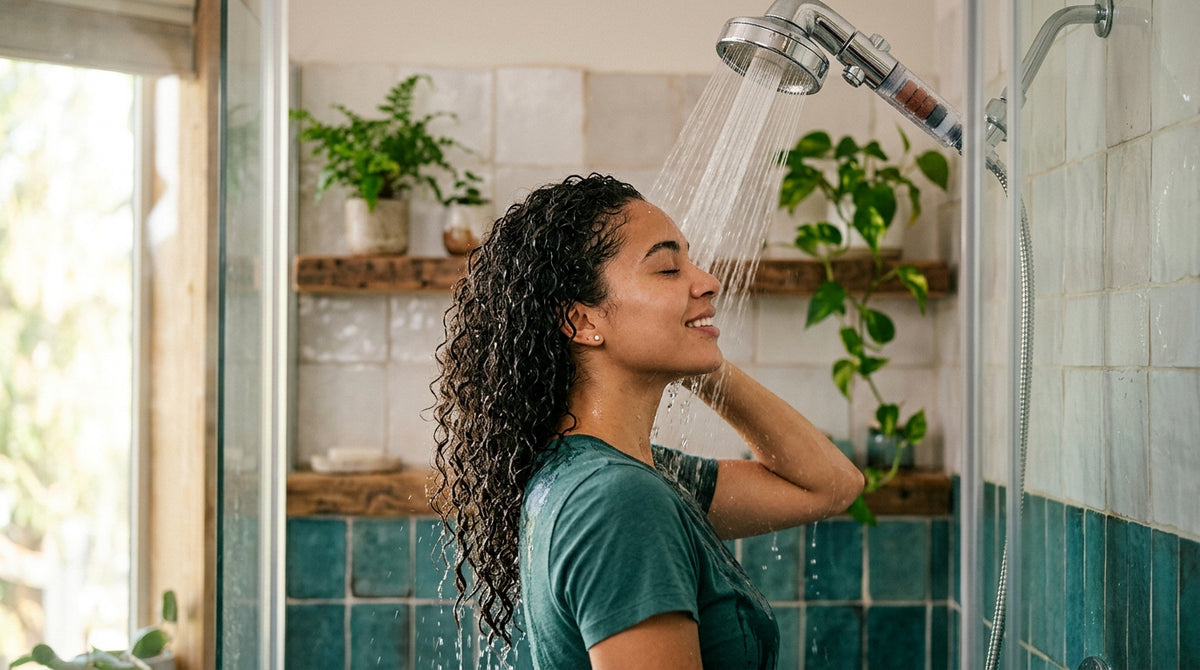
Your curls feel coated, dull, and weirdly stiff no matter how much conditioner you pile on. That's often mineral buildup talking, and the right clarifying shampoo for curly hair can strip it away without leaving strands feeling stripped bare. But swapping bottles only solves half the problem. This guide covers the nine best formulas worth trying, plus why what's coming out of your showerhead might matter just as much as what's in the bottle.
What Makes a Clarifying Shampoo for Curly Hair Different
Clarifying vs. Chelating: Why the Distinction Matters for Curls
Clarifying shampoos are the deep-clean option. They use stronger surfactants, sometimes sulfates like sodium laureth sulfate, to cut through product buildup, excess oil, and the mineral film hard water leaves behind. Think of it as a reset button. It's not meant for daily use. It's not gentle by design, either — it's built to strip, then get out of the way so your regular routine can work again.
Chelating shampoos do something more specific. They bind to metal ions — calcium, magnesium, iron — and pull them out of the hair shaft rather than just washing surface residue away. That's a different job. A clarifying shampoo might leave mineral deposits behind if hard water is your main issue, because surfactants alone don't always grab onto ions the way a chelator does. Curly-hair brands have started blending both approaches, but reading the label matters more than trusting the word "clarifying" on the front.
Here's the blunt part: if you're only clarifying, you might be cleaning the surface while the real problem sits deeper. Knowing signs your home has hard water helps you figure out whether you actually need a chelating step or just a good scrub. Curls also carry more risk here than straight hair. Higher porosity strands absorb both product and minerals faster, so buildup accumulates differently, and stripping it too aggressively can leave curls frizzy, rough, and stretched out of shape for days. Frequency and formula strength matter more for curls than for any other hair type — treat it like a scalpel, not a firehose.
How We Evaluated Each Shampoo
Testing Notes on Porosity and Curl Pattern
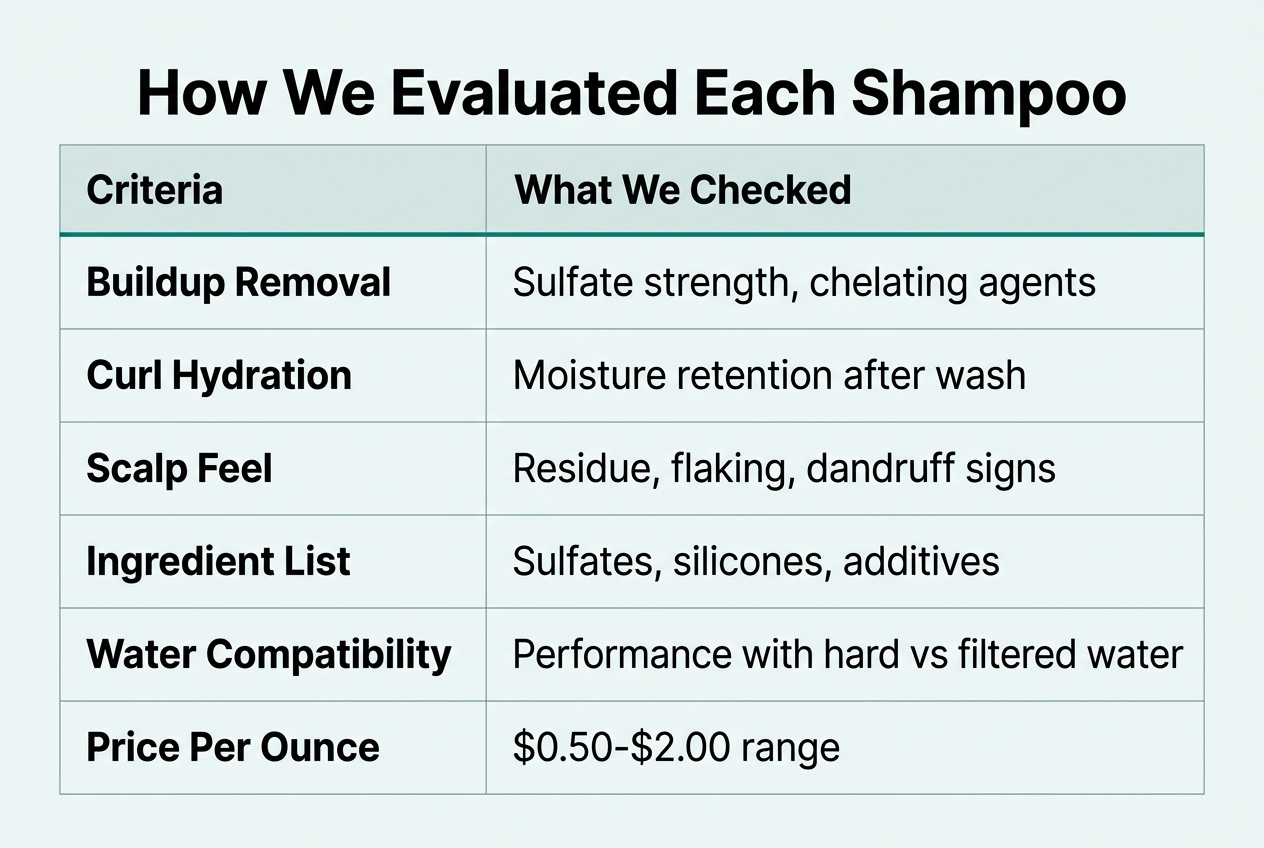
We didn't just sniff a bottle and call it a day. Each shampoo went through the same five-point check: ingredient list, lather and rinse-out feel, curl pattern retention post-wash, scent, and price per ounce. The ingredient scan mattered most, honestly. Some "clarifying" formulas lean on sulfates so aggressive they'd strip a bowling ball. Others use gentler surfactants like cocamidopropyl betaine that lift buildup without leaving curls feeling like straw. Price per ounce matters too, since a lot of these bottles look cheap on the shelf but run $2 or more per ounce once you do the math.
We split testers into low, medium, and high porosity groups because a shampoo that behaves on one curl type can flop on another. Low porosity hair, which resists moisture, showed the biggest difference in rinse-out feel — some formulas left a filmy residue that no amount of rinsing fixed. High porosity strands, already prone to frizz and dryness, revealed which shampoos left curls limp versus which kept a defined coil. Medium porosity landed in between most of the time, though scent longevity varied more than we expected across the board.
A few formulas needed backup. If a shampoo left hair feeling rough or squeaky, we noted whether it required a follow-up deep conditioner or oil treatment to restore softness. That's a real cost, both in money and in an extra step nobody wants on wash day. For readers curious about what's actually doing the work in a clarifying formula, the helios showerhead filter ingredients glossary is a useful reference for decoding labels before you buy.
9 Best Clarifying Shampoos for Curly Hair, Compared
Nine shampoos, nine different jobs. Some are built to strip years of mineral scale off your strands, others are gentle enough for curls that bruise easily under harsh cleansers. Before you buy, know which fight you're picking. Below is a quick spec sheet comparing price, sulfate status, ideal curl type, and the one ingredient that actually earns its spot on the label.
| Shampoo | Price | Sulfates | Best Curl Type | Standout Ingredient |
|---|---|---|---|---|
| Aveeno Apple Cider Vinegar Clarifying Shine | ~$9 | Sulfate-free | Wavy to medium curls | Apple cider vinegar |
| Bumble and Bumble Sunday Clarifying | ~$32 | Sulfate | All types, occasional use | Lemon extract |
| Curlsmith Curl Reset Detox | ~$28 | Sulfate-free | Coily, high-porosity curls | Sea kelp bioferment |
| Ion Purify Hard Water Shampoo | ~$15 | Sulfate | Fine to medium, mineral buildup | Chelating EDTA complex |
| Malibu C Undo Goo | ~$20 | Sulfate-free | All types, weekly reset | Crystalized cosmetic chelator |
Best for Hard Water Buildup
If you're washing under mineral-heavy water, Malibu C Undo Goo and Ion Purify are the two worth trusting. Undo Goo's crystalized chelator was designed specifically to lift calcium and magnesium deposits, the same scale that leaves curls stiff and faded after a few showers. Ion Purify uses an EDTA-based formula that does similar work at a lower price point, though it does contain sulfates, so it's not a daily driver. Bumble and Bumble Sunday sits in this category too, but it's the harshest of the bunch. Use it monthly, not weekly. None of these fix the water itself — they just clean up after it.
Best for Sensitive, Low-Porosity Curls
Low-porosity curls resist product and bruise easily under strong surfactants, so gentler formulas matter here. Aveeno's Apple Cider Vinegar Shine is mild enough for weekly use and won't over-strip already-resistant cuticles. Curlsmith's Curl Reset Detox leans on sea kelp bioferment, a softer clarifying agent that still clears product buildup without the squeaky, stripped feeling. The Ordinary's 4% Sulphate Cleanser is another low-cost option, technically a body-and-hair wash, but its low sulfate concentration makes it surprisingly curl-friendly for occasional resets. Ouidad Water Works and Paul Mitchell Clarifying Shampoo 2 both fall in the middle; effective, but formulated more for general buildup than porosity-specific care. QuickSilverHair's Squalane Kit rounds things out as a moisture-forward option paired with a light clarifying step, better suited to curls that clarify often and need the fatty-acid replenishment right after. For readers building a full rotation, it's worth understanding how sulfate free shampoo for curly hair options perform differently on porosity before committing to one bottle.
Worth noting: none of these nine shampoos change what's coming out of your shower head between washes. If your neck and shoulders are tense from hunching over a sink scrubbing out buildup, that's a separate problem — one massage for neck & shoulder pain guide covers well, alongside general ergonomics advice for anyone spending too long at a bathroom mirror or a desk.
A Note on Apple Cider Vinegar and Hair Porosity
ACV rinses get recommended everywhere, but they're not universally kind to curls. Apple cider vinegar is acidic, which helps seal the cuticle and cut through mineral film. Fine, in theory. On high-porosity or color-treated hair, though, that same acidity can strip further, leaving strands feeling straw-like within a week or two. If your curls already gulp down product and dry out fast, an ACV formula can push things past dry into brittle.
Low-porosity curls tend to fare better. Tighter cuticles resist the acid's pull, so you get the clarifying benefit without much of the downside. That's the whole trick with porosity: what soothes one curl pattern can wreck another. There's no universal fix here, whatever the bottle promises.
Before committing, patch test on one small section, maybe a nape strand, for a week. Watch how it dries, not just how it feels wet. If it's tight or squeaky, that's a warning sign, not a win. Always follow with a moisturizing conditioner or mask to rebalance pH and replace lost moisture, especially if you're also dealing with hard water pulling extra moisture from your strands between washes.
How to Use a Clarifying Shampoo Without Overdoing It
Clarifying shampoo works. That's the problem. It strips buildup so well that it's easy to get carried away and strip your curls' natural oils right along with it. A little discipline here saves you months of frizz recovery.
- Read the label before you buy — sulfates like sodium lauryl sulfate clean hardest and fastest, while gentler surfactants such as cocamidopropyl betaine or decyl glucoside still lift buildup but leave more moisture behind for curl patterns that dry out easily.
- Apply to the scalp first, not the ends — section your hair into four parts, work the shampoo into your roots where oil and product actually collect, then let the lather run down the lengths as you rinse instead of scrubbing it in twice.
- Space out sessions based on your routine — once every 1 to 3 weeks is typical, with heavy gel and mousse users leaning toward weekly and low-maintenance curlies stretching closer to the three-week mark, especially with harder water pushing mineral buildup faster.
- Never skip the follow-up conditioner — a deep conditioner or protein-free moisturizing mask replaces what clarifying removes; curls left without it will feel like straw within a day.
- Watch how your curls respond over the next few washes — new frizz, brittleness, or dullness that wasn't there before usually means you've over-clarified and need to back off the schedule.
When your curls seem confused
If you're doing everything right and your hair still looks dull two days after washing, the shampoo probably isn't the culprit. Hard water minerals can undo a clarifying session almost immediately by coating strands right after you rinse. Many people test their water hardness through a local service first, then decide whether their haircare routine or their water supply is really the issue.
Why Hard Water Undoes Your Clarifying Routine Fast
Here's the frustrating part nobody warns you about: you clarify, your curls feel great for a day or two, and then the dullness creeps right back. That's because calcium and magnesium in hard water don't stop showing up just because you washed them out once. Every rinse redeposits more mineral film onto your strands, along with chlorine residue that dulls shine and roughens the cuticle. You're not imagining it. You're fighting the same buildup on repeat.
Signs Your Water, Not Your Shampoo Routine, Is the Problem
If your curls feel coated within days of clarifying, that's a big tell. So is hair that won't hold moisture no matter how rich the conditioner, or curl clumps that separate into frizz by midweek. Some people also notice a faint film on shower glass or a chalky residue on faucets — that's the same mineral load landing on your scalp and hair.
A lot of curly-hair owners in hard water regions end up clarifying weekly instead of monthly just to keep up. That's rough on curl pattern. Frequent clarifying strips natural oils faster than they can replenish, leaving hair more porous and more prone to frizz — the exact opposite of what you're trying to fix.
Color-treated curls show it even faster, with fading and brassiness showing up between salon visits. If you're clarifying constantly and still seeing dullness, the shampoo probably isn't the weak link. The water hitting your hair before, during, and after every wash likely is.
Many people confirm this by testing their water hardness elsewhere first — a simple hardness test kit or a local water report will tell you the mineral count. Once hardness is confirmed, point-of-use filtration becomes the logical next step, reducing mineral and chlorine exposure right at the showerhead or sink before it ever reaches your curls.
Filtering the Water Before It Ever Touches Your Curls
DIY Install: What to Expect With a Filtered Showerhead
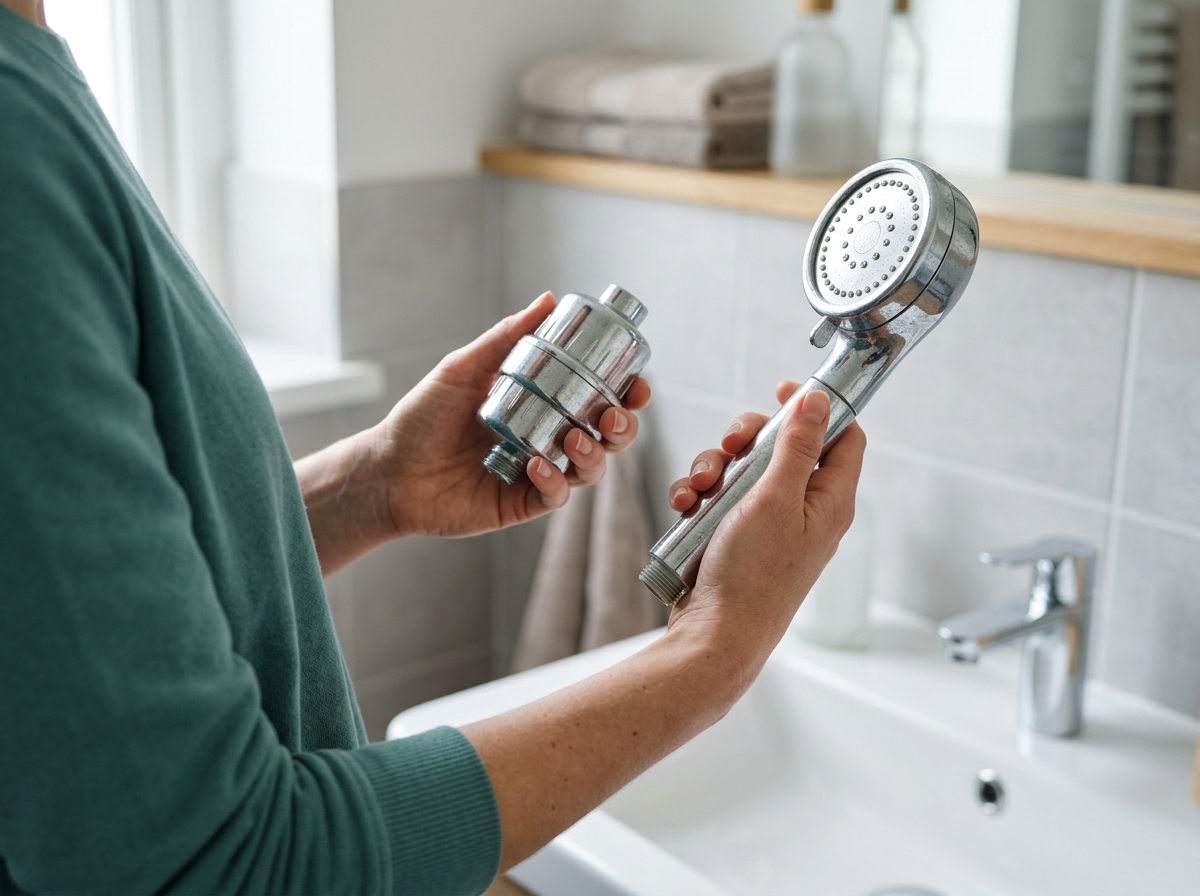
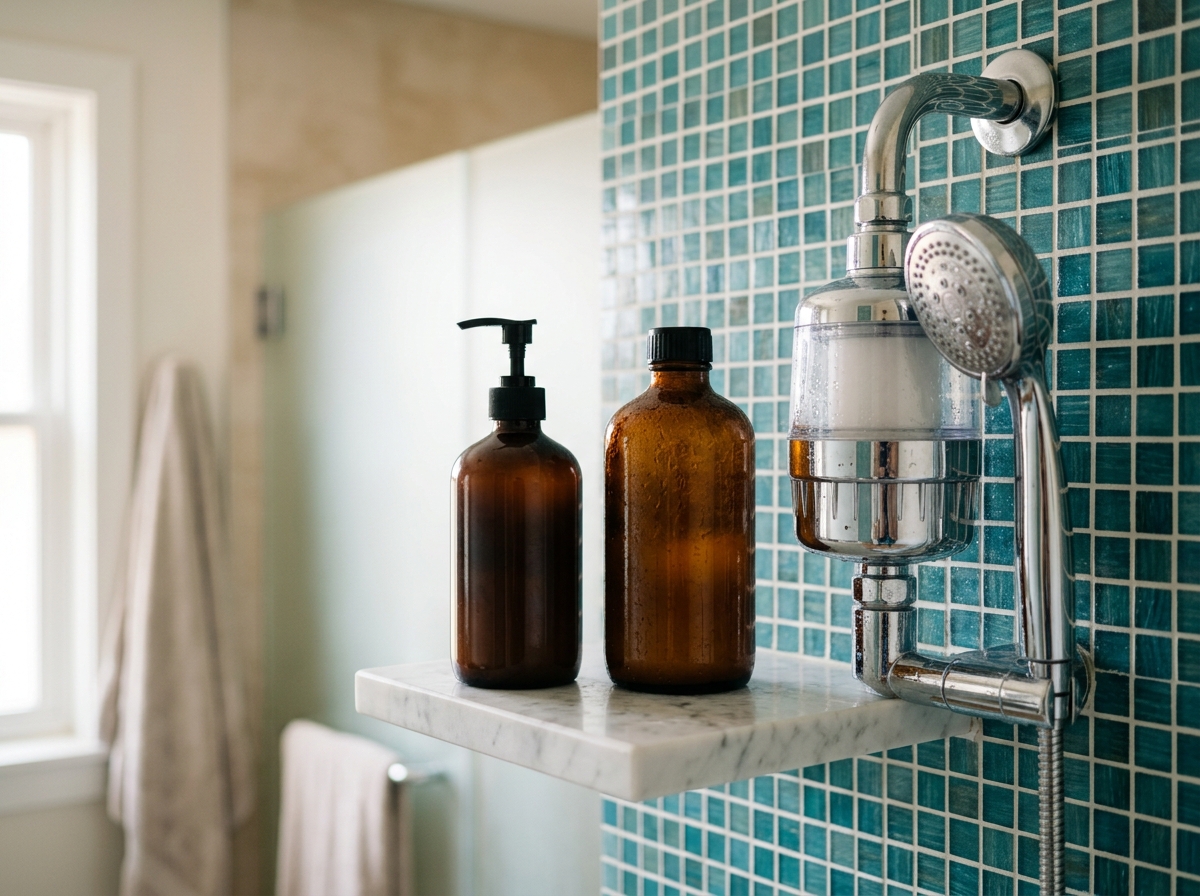
A filtered showerhead reduces chlorine and hard water minerals right at the point of use. No plumber, no whole-home softener, no weekend torn apart by a renovation project. You unscrew your current showerhead, wrap the threads, screw on the new one. Most people are done in under ten minutes. That's the whole install.
For curly hair, this matters more than it sounds like it should. Curls are already fighting for moisture and definition. Add mineral deposits from hard water on top, and you're rinsing shampoo out through a layer of scale that never quite lets go. Softer-feeling water at the source means less of that buildup forming in the first place, which is the whole point.
Renters especially benefit here since it's fully reversible. Take it with you when you move. Under-sink filters follow the same logic for the sink you actually co-wash or detangle over — same point-of-use approach, same no-plumber install, just a different fixture. If you co-wash mid-week and only shower-wash on weekends, covering both spots matters more than covering just one.
Vitamin-Infused Cartridges and Keeping Filtration Consistent
Vitamin-infused filter cartridges are part of the filtration hardware itself, not a leave-in treatment or a bottle you'd find on a shelf. They sit inside the showerhead or under-sink unit and work on the water before it ever reaches your strands. Think of it as improving the input, not adding another step to your routine.
A replacement filter subscription keeps that performance from quietly fading. Cartridges lose effectiveness over months of constant mineral exposure, and nobody remembers to swap a filter on their own schedule. Automating it means fresh filtration keeps showing up between your clarifying washes, not just right after you buy the unit.
None of this replaces a clarifying shampoo, and it shouldn't try to. What it does is reduce how often you need one. Less mineral buildup accumulating day to day means less heavy-duty stripping needed later. Your shampoo does less rescue work. That's the actual win here — not a replacement, a lighter load.
Building a Full Anti-Buildup Routine for Curly Hair
A clarifying wash is one piece of a routine, not the whole thing. Do it alone, once, and forget about it, and your curls will be right back where they started in three weeks. The goal is a rhythm you can actually keep up.
- Monthly clarifying, weekly gentle cleansing: use the deep clarifying shampoo once a month, and fill the gaps with a sulfate-free co-wash or low-lather cleanser so buildup never gets the chance to pile up.
- Deep condition or protein-treat right after clarifying: clarifying strips more than gunk — it takes some moisture and protein with it, so a rich mask or reconstructor the same day keeps curls from feeling straw-like.
- Filter the water at the showerhead between washes: softer, lower-mineral water slows down the mineral film and product residue that force you into clarifying more often than you'd like.
- Keep shampoo bottles away from steam and humidity: active ingredients like apple cider vinegar or chelating agents break down faster in a hot, wet bathroom, so a linen closet or dry cabinet extends shelf life.
- Track wash days in a quick journal: jot down curl definition, frizz, and how many days it took for buildup to return, so you can adjust frequency instead of guessing.
None of this needs to be fancy. A sticky note on the mirror works as well as an app.
Ultimately it comes down to what problem you're actually trying to solve — a rented softener treats every tap in the house, while point-of-use filters at the shower and sink focus narrowly on the water touching your skin and hair each day. It's worth asking whether whole-home coverage matters to you or whether a simpler, plumber-free swap at the fixtures you use most gets you close enough to the result you want. Either way, knowing what's actually in your water first tends to make that decision a lot less guesswork.
Share:
Medicated Shampoo for Itchy Scalp: How Hard Water Makes It Worse
Antifungal Shampoo Guide: Treating Scalp Fungus Caused by Mineral-Heavy Water